A desk for the buildings with no windows
India's newest heavy industry has no chimney and no shift horn. It has land, power, water, subsidies and a cable landing. Why Vayam is opening a desk for it.
The short version · five beatsOpen ↓Close ↑
- AnchorThe cloud: where your photos, payments and chat history are said to live.
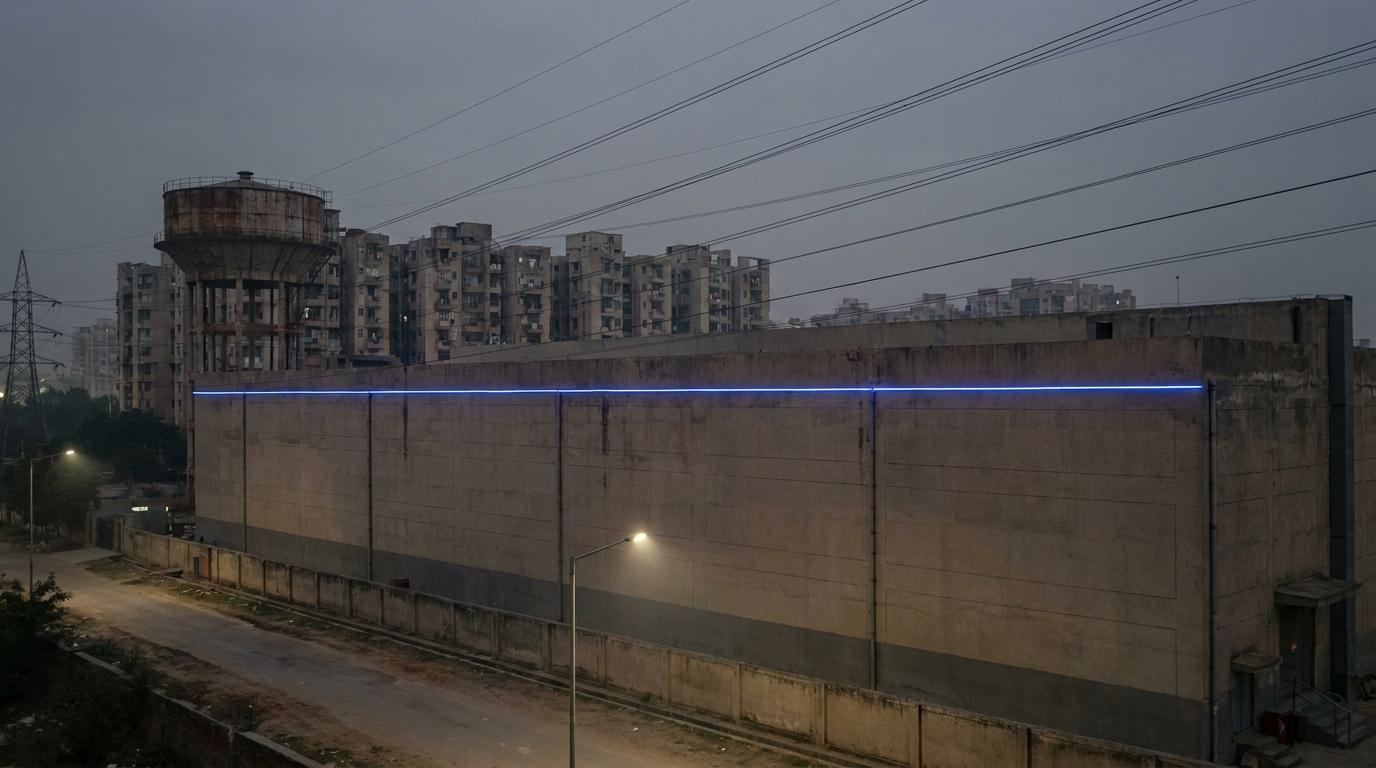
- CrackThe cloud is a set of windowless sheds in Navi Mumbai, Chennai and Hyderabad, together approaching two gigawatts of capacity.
- MachineLand assembled by states, round-the-clock power from a grid at record peaks, water, tax holidays and subsea cable landings: a heavy industry in the shape of a warehouse.
- The truthThree state decisions — a payments-data rule, a tax bargain and a state's incentive cheque — built most of it, and none was called industrial policy.
- Send-lineIndia's newest heavy industry doesn't look like one. That is exactly why it needs watching.
Some time this year, India's data centres will cross two gigawatts. That is CBRE's count, and on CBRE's count the industry added about 130 MW in the first half of 2026 and expects more than 200 MW in the second. Two gigawatts is a power plant. Nobody will cut a ribbon on it, because it is not in one place. It is spread across windowless sheds in Navi Mumbai, Chennai, Hyderabad and Noida, and the people who live next to them mostly do not know what they are.
We are opening a desk for those buildings.
Why a media house about industry needs this desk
Vayam was started to explain the parts of India's economy that the government still shapes and the headlines still skip: coal, steel, petroleum, power, defence, rail, roads. A data centre does not look like it belongs on that list. It has no chimney, no furnace and no shift horn. But read what it needs and the list is familiar. It needs land, assembled by a state. It needs power, around the clock, from a grid that set a record of 270.82 GW at 3:47 pm on 21 May 2026. It needs water, or a reason not to. It needs a subsidy, a tax ruling and a cable landing. That is a heavy industry. It just arrived in the shape of a warehouse.
The money says so too. CBRE counts about USD 173 billion of commitments since 2021. Committed is not spent, and our Numbers desk shows the gap between the two in the capacity brief. But capital on that scale does not go into a sector the state does not shape. It goes in because the state shaped it.
What the state actually did
Three decisions built most of this industry, and none of them was called industrial policy.
The first was a compliance rule. On 6 April 2018 the Reserve Bank of India told every payment system operator that the entire data relating to their payments must be stored in a system only in India. In September 2026, UPI averaged 802 million payments a day. Every one of them is a tenant of a building in India. Our Explainer desk follows one of those payments from a chai stall to a server in scan a QR, rent a building.
The second was a bargain with foreign clouds. The Union Budget for 2026-27 offered a tax holiday to 2047 to foreign companies serving the world from Indian data centres. The Argument desk reads the terms in the 2047 tax holiday, read carefully.
The third was a state's cheque. Andhra Pradesh's government order for Google's Visakhapatnam project caps the incentives at ₹22,002 crore. It is a ceiling, not money spent, and the agreement behind it is not public. The Places desk walks the land in Visakhapatnam, the AI coast. The Argument desk asks what the ceiling buys in jobs in thirty jobs per hundred megawatts.
What the machine costs, and who pays
A typical 100 MW hyperscale data centre can use about two million litres of water a day for cooling, on the International Energy Agency's estimate as cited by CEEW. India has more than 18% of the world's people and about 4% of its renewable water. Until Karnataka's new policy this autumn, no Indian rule asked a data centre to report its water use building by building. That is the subject of the building that drinks, and of the questions we will keep asking.
The grid is the other bill. Our Numbers desk sets the projections side by side in the grid before the plan. The short version: every gigawatt of compute is joining the grid as firm demand at peak, the most expensive way to add it.
How this desk will work
Every piece on this desk is signed by a desk, not a person. Ganak counts. Sutradhar explains. Yatri reads places. Tarka argues. Itihas remembers: India's public internet went live on 15 August 1995, three months after Beijing's, and India's first commercial data centre opened at Vashi in September 2000. The History desk begins there. Each pen-name has written voice rules, which we publish on its page. None of them is a person, and we will not pretend otherwise.
Every number links to where it came from. For capacity and investment, the house source is CBRE, because it is the most recent, most cited and most complete series, and other houses appear only where CBRE is silent or where the disagreement is the story. We never average one consultancy's estimate with another's. Where a figure does not exist, we say so. In this industry that happens often: no Indian operator publishes metered water use, and nobody publishes how many of the state's subsidised GPU-hours were actually used.
Here is what we will watch
- Whether the national data centre policy, drafted in 2020 and again in 2025, is ever notified.
- Whether Karnataka's water reporting becomes a national rule, or stays one state's experiment.
- Whether the first 120 MW at Jamnagar is switched on by the end of 2026, as Reliance has promised.
- Whether India's AI chips keep arriving on Washington's terms or on written ones.
- Who sits on the land at Tarluvada when the court cases end.
The machine, not the press release.
Sources 7
- Beyond growth: India's rise among APAC's leading data centre markets — CBRE India, 2026-09
- India likely to add more than 200 MW of new data centre capacity in H2 2026 (CBRE) — NBM&CW, 2026-09
- Storage of Payment System Data (circular, 6 April 2018) — Reserve Bank of India, 2018-04-06
- Scaling India's Data Centre Ecosystem (white paper) — CEEW, 2026-02
- Google's Raiden Infotech to get ₹22,000 crore as incentives from Andhra (PTI) — The Hindu BusinessLine, 2025-10
- Karnataka's new data centre policy puts water, energy in focus — The News Minute, 2026-09
- Chairman's Statement at the 49th AGM — Reliance Industries, 2026
Every figure in this piece, and where it comes from 13 checked ↓
- CBRE: ~130 MW added H1 2026; >200 MW expected H2; on track for 2 GW by end-2026 — source
- CBRE: ~USD 173 bn cumulative commitments since 2021; Mumbai 52% of operational stock — source
- India's all-time peak demand 270.82 GW, 3:47 pm, 21 May 2026 — source
- RBI circular, 6 April 2018: entire payment system data stored in a system only in India — source
- UPI averaged 802 million payments a day in September 2026 — source
- AP GO Ms No. 40 (11 Oct 2025): overall incentive cap of ₹22,002 crore for Google's Raiden Infotech project — source
- A typical 100 MW hyperscale data centre can consume ~2 million litres/day for cooling (IEA via CEEW) — source
- India has more than 18% of world population and 4% of world's renewable water resources — source
- Karnataka Sustainable Data Centre Policy 2026-31 requires plant-wise PUE and WUE reporting — source
- VSNL's public internet (GIAS) launched 15 August 1995 — source
- China opened internet access to the public on 17 May 1995 in Beijing — source
- Sify's Vashi facility, launched September 2000, was India's first commercial data centre — source
- Reliance: first 120 MW of Jamnagar AI compute promised for commissioning by end-2026 — source
In this story 6
Vayam Desk — “we” — the masthead speaking
The masthead speaking: plural, calm, compressed — a principle, two numbers, and a line that sounds like a stamp on a machine.
More from the desk
AI & Data Centers →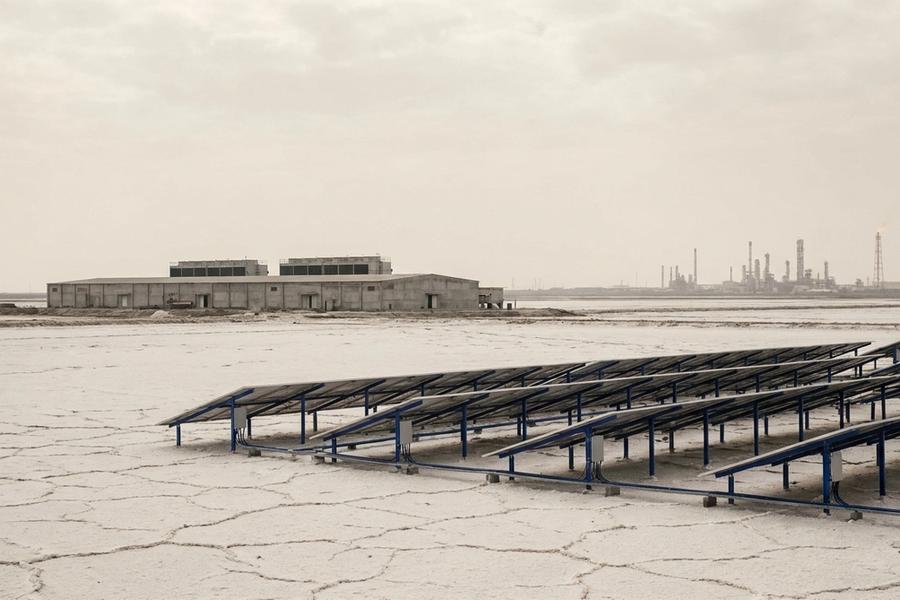
Jamnagar: why Reliance is building India's AI backbone next to its refinery
A quarter of India's refining capacity sits in one Reliance fence. Now the same site is promised 120 MW of AI compute by December, on solar power that has not yet arrived.
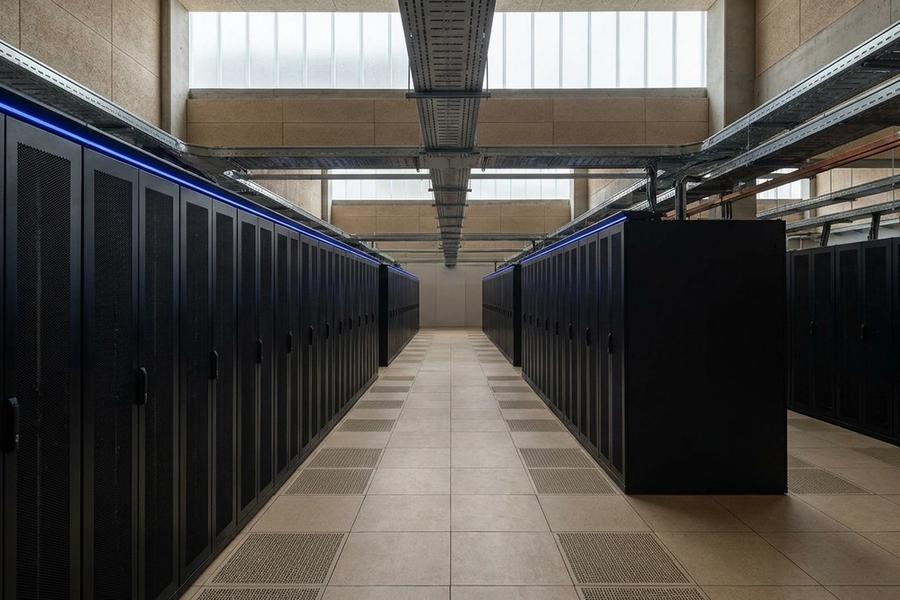
What is a megawatt of data centre? A field guide to MW, PUE, Tiers and GPU-hours
MeitY says India has about 1,575 MW of data centres. CBRE says it is heading for 2 GW. Both are right. Here is what every word in those headlines is actually counting.
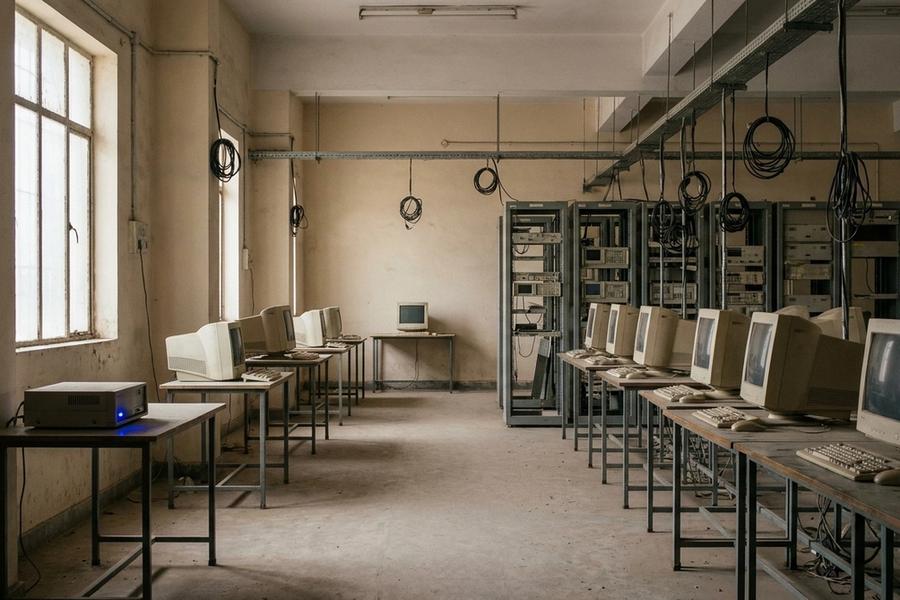
Online before China? The 1995 boast, and the state decisions behind India's data centres
VSNL's Independence Day internet was not first in Asia. What it began was a chain of state choices, from STPI's earth stations to RBI's data rule, that private capital has filled ever since.