Jamnagar: why Reliance is building India's AI backbone next to its refinery
A quarter of India's refining capacity sits in one Reliance fence. Now the same site is promised 120 MW of AI compute by December, on solar power that has not yet arrived.
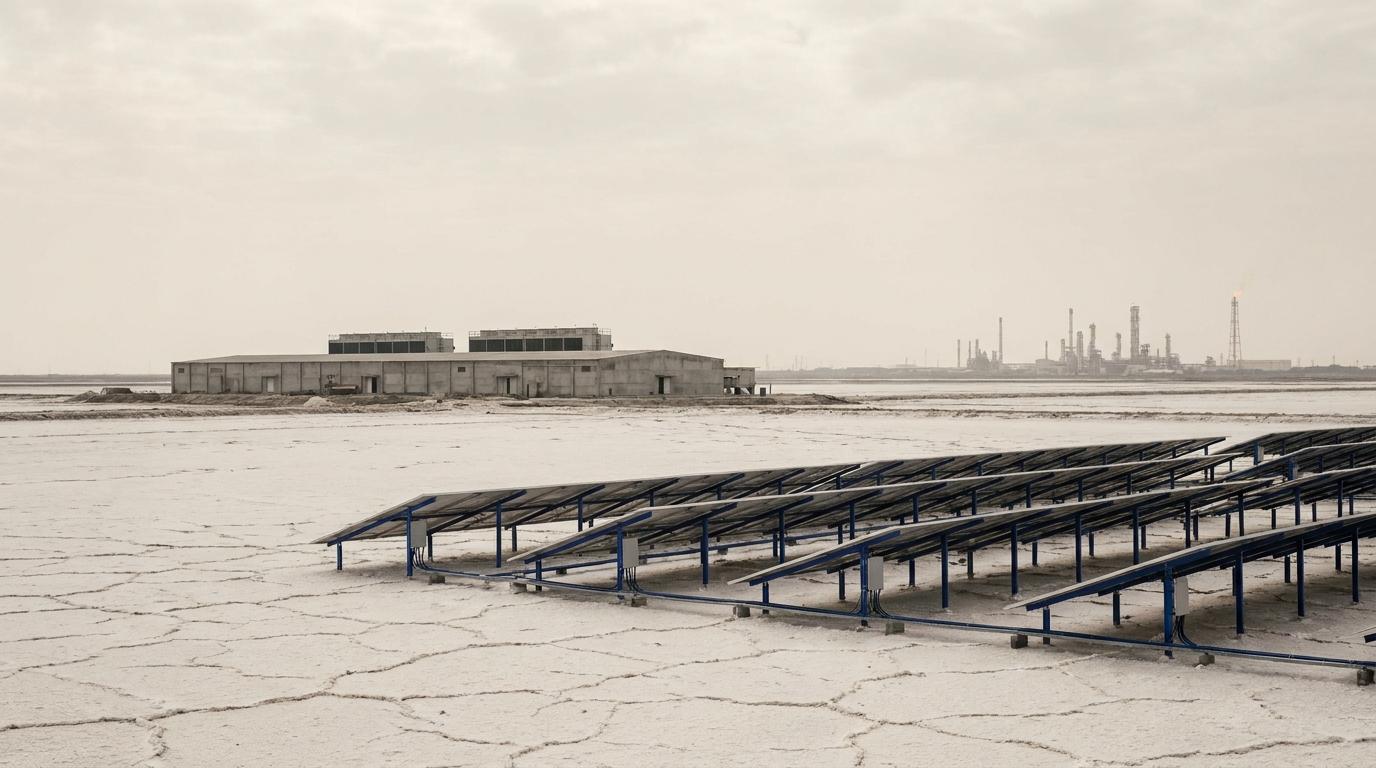
The short version · five beatsOpen ↓Close ↑
- AnchorThe fuel in your scooter and the plastic in your bucket: Reliance's Jamnagar refinery holds 68.2 of India's 258.1 million tonnes a year of refining capacity.
- CrackThe same fence is where Reliance says it is building India's 'sovereign AI backbone', with the first 120 MW due by end-2026.
- MachineA 1.4 million barrel-a-day refinery (1999, 2008), a 5,50,000-acre Kutch solar platform, in-house module and battery factories, Jio's network and subsea cables, NVIDIA GB300s, and a 168 MW hall leased to Meta.
- The truthJamnagar is sited on energy logic, not cable logic, and Reliance would own fuel, pipe, compute and distribution at once; but as of October 2026 the compute and the Kutch power are both still promises.
- Send-lineEveryone else built data centres near the cables. Reliance is building one next to its own power.
Fill a scooter, buy a bucket, pull on a polyester shirt, and there is a fair chance some part of it began as crude oil unloaded on the Gulf of Kutch. India can refine 258.1 million tonnes of crude a year across its refineries. According to the petroleum ministry's technology centre, 68.2 million tonnes of that capacity, roughly one tonne in four, sits inside a single company's fence at Jamnagar in Gujarat.
That fence is now being asked to hold something else. In June 2026, Reliance Industries told its shareholders that Jamnagar would host what it calls India's "sovereign AI backbone". The refinery town is becoming a compute town, and the reasons it was chosen say more about Reliance than about data centres.
The refinery that made the town
Reliance describes Jamnagar as "the largest and most complex single-site refinery in the world", with 1.4 million barrels per day of crude processing capacity and a complexity index of 21.1, a measure of how many different, harder-to-refine crudes a plant can turn into finished products. The company says the refinery has processed over 216 grades of crude. Its marine facility can berth very large crude carriers.
It was built in two pieces. The petroleum ministry's list dates the first refinery, for the domestic market, to 1999 (33 million tonnes a year) and the second, inside a special economic zone, to 2008 (35.2 million tonnes). Beside them sits the world's largest refinery off-gas cracker, feeding polyethylene and MEG plants, the raw material of buckets, films and polyester.
What Jamnagar has, in other words, is everything heavy industry needs in bulk: a port, land, water infrastructure, a transmission connection, and a company used to building plants measured in gigawatts and millions of tonnes.
From refinery to compute, in five announcements
The AI story arrived in instalments, and it helps to keep them separate.
- October 2024: at NVIDIA's AI summit in Mumbai, NVIDIA committed to supply Blackwell processors for a one-gigawatt data centre Reliance planned to build, as Business Standard recounted. In January 2025 the same paper, citing Bloomberg, reported that Reliance would build "the world's largest data centre" at Jamnagar and had procured NVIDIA chips.
- August 2025: Reliance announced Reliance Intelligence, a wholly owned AI subsidiary, alongside a Google Cloud region at Jamnagar; a Reliance executive told analysts in October 2025 the first phase targeted 100 MW over two years.
- 19 February 2026: Mukesh Ambani unveiled a ₹10 trillion plan, about USD 110 billion over seven years, for gigawatt-scale data centres, edge computing and AI services, saying construction of multi-gigawatt data centres at Jamnagar had begun and more than 120 MW would come online in the second half of 2026.
- 10 June 2026: Reliance and Meta announced a 168 MW data centre at Jamnagar, built to suit and leased to Meta, "to be delivered within two years," cooled with desalinated seawater.
- 19 June 2026: at the 49th AGM, the chairman's statement set the deadline: "The first 120 megawatts will be commissioned by the end of 2026."
“Reliance Intelligence is building India's sovereign AI backbone in Jamnagar. This cutting-edge infrastructure will be powered entirely by clean energy from Reliance's own solar generation from the Kutch renewable platform.”
— Chairman's statement, Reliance Industries 49th AGM, 19 June 2026The same statement says Reliance is "operationalising an initial fleet of advanced NVIDIA GB300 GPUs," equal to "more than 75,000 H100 GPUs on an AI-inference basis," scaling to "over two lakh H100-equivalent GPUs" as the 120 MW becomes fully operational. Note the unit. Reliance converts its fleet into an older chip's equivalent on an inference basis; it has not published how many GB300s it has bought.
Energy logic, not cable logic
Most of India's data-centre capacity follows the cables. On CBRE's count, Mumbai held 52% of operational stock at the end of June 2026, in micro-markets CBRE says are anchored by multiple cable landing stations. Google's Visakhapatnam hub begins by building a new subsea gateway. Our piece on why data centres live by the sea explains that pull.
Jamnagar is on the coast too, but the cable is not why it was chosen. Read the order in Reliance's Meta release: "delivery capability, renewable energy, water availability, proximity to India's western submarine cable landing stations and Jio's extensive fibre network." Proximity to landing stations, not a landing at Jamnagar. The reason that comes first is power.
That power is meant to come from Kutch, across the gulf. At the 2025 AGM, Anant Ambani described "one of the world's largest single-site solar projects spanning 5,50,000 acres of arid land," which he said could meet nearly 10% of India's electricity needs within a decade, built at a peak pace of 55 MW of solar modules and 150 MWh of battery containers a day. The modules and batteries are to come from Reliance's own giga-factories at Jamnagar.
“All of this round-the-clock power ultimately comes to Jamnagar to feed our refinery, our new energy projects, data center, which is again scaling up at speed.”
— Karan Suri, Reliance New Energy, Q1 FY27 earnings call, July 2026That sentence, from Reliance's July 2026 earnings call, is the whole siting thesis. Jamnagar is being designed as a customer of its owner's own power plant.
Fuel, pipe, compute, distribution
What makes the site unusual in India is less the megawatts than the ownership chain around them. Reliance, or a company it controls, holds each layer:
- Fuel: the Kutch solar and battery platform, and the Jamnagar factories making its modules and cells. In July 2026 Reliance said it had produced about 1 GW of solar modules there.
- Pipe: Jio's network, and the two subsea systems it announced in 2021, India-Asia-Xpress and India-Europe-Xpress, together more than 16,000 km and 200 Tbps, landing at Mumbai and Chennai.
- Compute: the Jamnagar halls, its own and Meta's.
- Distribution: Jio, with over 533 million subscribers at the end of June 2026, and the AI services Reliance has named for them: JioBharatIQ, JioHealthIQ, JioLearnIQ, JioKrishiIQ.
None of the hyperscalers building in India owns all four layers itself; Google's Visakhapatnam hub, for one, is built with AdaniConneX and Airtel. Reliance's partners (NVIDIA for chips, Google and Meta for models and tenancy) plug into a stack whose physical layers it already owns. That is the audacious part, and also the concentrated part: the same group would sell the electricity, the connection, the compute and the app.
Announced, operational, undisclosed
Separate the three tenses carefully.
Operational: the refinery, Jio's network, and the first solar module and cell lines at Jamnagar.
Announced, with dates: 120 MW of AI compute by the end of 2026; Meta's 168 MW within two years of June 2026. We found no Reliance announcement, as of 20 October 2026, that the 120 MW is live; its own deadline is about ten weeks away. Kutch power is also still a promise. On the July 2026 call, Reliance said it expected to start solar installation in Kutch "after the monsoons" and to supply power "this year" as the transmission network gets ready. So the claim that the campus will run "entirely" on Kutch solar describes a plan, not a present fact.
Not disclosed: the number of GPUs (only H100-equivalents), the campus's power-usage and water-usage efficiency, the price of compute, who besides Reliance's own services and Meta will rent it, and how the 120 MW and Meta's 168 MW relate on the ground. The Kutch figures also do not quite line up: the 2025 AGM promised nearly 10% of India's electricity within a decade, while Reliance has given no installed-capacity figure or completion date for the site, as PTI noted.
What to watch
- 31 December 2026. Whether Reliance reports the first 120 MW as commissioned, and on what power.
- Kutch transmission. The first electrons from Kutch reaching Jamnagar is the test of the energy-logic thesis. Solar does not run at night; Reliance's answer is batteries at gigawatt-hour scale, made in its own factory.
- The tenant list. A campus built for "sovereign" compute that leases its first named block to an American platform is not a contradiction, but it is a choice. Our piece on sovereign models and rented silicon takes up that tension.
Jamnagar was built once to turn imported crude into exported fuel. Reliance is now betting it can turn sunlight from across the gulf into compute. The refinery took 1999 to 2008. The AI campus has given itself until December.
Sources 18
- Refineries — current refining capacity as on 01.04.2025 — Centre for High Technology, MoPNG, 2025-04
- Refining capacity — Ministry of Petroleum and Natural Gas, n.d.
- Petroleum Refining & Marketing — Jamnagar — Reliance Industries, 2026
- Integrated Annual Report 2022-23 — Manufactured Capital — Reliance Industries, 2023
- India's AI push: Reliance to build world's largest data centre in Jamnagar — Business Standard, 2025-01-24
- What Is Reliance Intelligence? Ambani's AI Plan Explained — FirstReport.News, 2026-09-18
- Q2FY26 Reliance Earnings — Focus on AI Infra & Quick Commerce — MediaNama, 2025-10-23
- Reliance unveils $110B AI investment plan as India ramps up tech ambitions — TechCrunch, 2026-02-19
- Reliance and Meta to Develop AI-Enabled Data Centre in Jamnagar, Gujarat — Reliance Industries, 2026-06-10
- Chairman's Statement, 49th AGM — Reliance Industries, 2026-06-19
- Beyond Growth: India's Rise Among APAC's Leading Data Centre Markets — CBRE India, 2026-09-21
- India's data centre capacity to hit 2 GW by 2026-end: CBRE — ETTelecom, 2026-10-06
- The Lure of Kutch: Ambani, Adani pledge billions for clean energy in arid heartland — The Hindu BusinessLine (PTI), 2025-08-31
- Webcast & Transcript for the Quarterly Results (Q1 FY27) — Reliance Industries, 2026-07
- Reliance Advances Ingot, Wafer Lines, Targets 40 GWh Batteries — TaiyangNews, 2026-07-21
- India at the Center of Two New Subsea Cable Systems — Reliance Jio, 2021-05-17
- Media Release: Consolidated results for quarter ended 30 June 2026 — Reliance Industries, 2026-07-17
- Our First AI Hub in India, Powered by a $15 Billion Investment — Google, 2025-10-14
Every figure in this piece, and where it comes from 18 checked ↓
- India refining capacity 258.1 MMTPA; Reliance Jamnagar DTA 33.0 + SEZ 35.2 = 68.2 MMTPA — source
- Jamnagar: largest and most complex single-site refinery in the world, 1.4 MMBPD, complexity index 21.1, 216+ crude grades, VLCC berthing — source
- DTA-Jamnagar refinery dated 1999; SEZ-Jamnagar dated 2008 — source
- World's largest ROGC complex with downstream LLDPE, LDPE and MEG plants in Jamnagar — source
- Oct 2024 NVIDIA summit: Blackwell processors for a 1 GW Reliance data centre; Jan 2025 Bloomberg report of world's largest data centre at Jamnagar — source
- Reliance Intelligence announced 29 Aug 2025; Google Cloud region at Jamnagar announced Aug 2025 — source
- Oct 2025 earnings call: first phase targeting 100 MW over two years; GCP region in Jamnagar — source
- ₹10 trillion (~USD 110 bn) seven-year AI plan; multi-GW construction begun at Jamnagar; >120 MW online H2 2026 — source
- RIL–Meta 168 MW Jamnagar data centre, delivered within two years, renewable power, desalinated seawater cooling; site reasons listed — source
- AGM 2026: first 120 MW commissioned by end-2026; GB300 fleet >75,000 H100-equivalent (inference), >2 lakh at full 120 MW; powered entirely by Kutch solar — source
- Mumbai 52% of operational stock (CBRE, end-H1 2026) — source
- Navi Mumbai micro-market benefits from multiple cable landing stations (CBRE) — source
- Kutch: 5,50,000 acres; 55 MW modules and 150 MWh batteries per day at peak; could meet ~10% of India's electricity within a decade; no capacity or timeline given — source
- Karan Suri, Q1 FY27 call: Kutch installation after the monsoons; power from Kutch this year as transmission gets ready; power comes to Jamnagar for refinery, new energy, data center — source
- About 1 GW of ALMM-certified HJT modules produced at Jamnagar (July 2026) — source
- Jio IAX and IEX: >16,000 km, >200 Tbps, landing Mumbai and Chennai (2021 announcement) — source
- Jio subscriber base over 533 million (quarter ended 30 June 2026) — source
- Google's Vizag hub includes a new subsea gateway; built with AdaniConneX and Airtel — source
In this story 9
Itihas — “so it was”
Narrative and dated: treats institutions as characters, loves the precise date and the forgotten first, and connects every origin to this year.
More from the desk
AI & Data Centers →
What is a megawatt of data centre? A field guide to MW, PUE, Tiers and GPU-hours
MeitY says India has about 1,575 MW of data centres. CBRE says it is heading for 2 GW. Both are right. Here is what every word in those headlines is actually counting.
Online before China? The 1995 boast, and the state decisions behind India's data centres
VSNL's Independence Day internet was not first in Asia. What it began was a chain of state choices, from STPI's earth stations to RBI's data rule, that private capital has filled ever since.
The 2047 tax holiday, read carefully: the concrete must be Indian, but only on paper
India will not tax foreign cloud firms' global income from Indian data centres until 2047. An August amendment lowered the gates further. What the bargain asks for in return is thinner than it sounds.