The grid before the plan: data centres are joining India's peak the costliest way
India's power demand set a record of 270.82 GW on 21 May. Data centres are a sliver of it today, are projected to grow 20-fold, and are being wired in as firm, doubled, peak-hour load.
The short version · five beatsOpen ↓Close ↑
- AnchorYour AC at 3:47 pm on 21 May 2026, when India's demand hit a record 270.82 GW.
- CrackInside that peak sits a load with no afternoon: data centres, about 1.1 GW of average draw today, projected to reach roughly 21.8 GW by 2040.
- MachineFull-capacity discom connections, 100% redundancy under CEA's 2026 manual, diesel and UPS by design, renewable PPAs on the side, and no market paying for flexibility.
- The truthEvery gigawatt of compute is contracted as firm demand at peak, and discoms carry stranded capacity whose fixed costs land on other consumers.
- Send-lineEvery gigawatt of compute joins India's grid as firm demand at peak: the costliest way to add it.
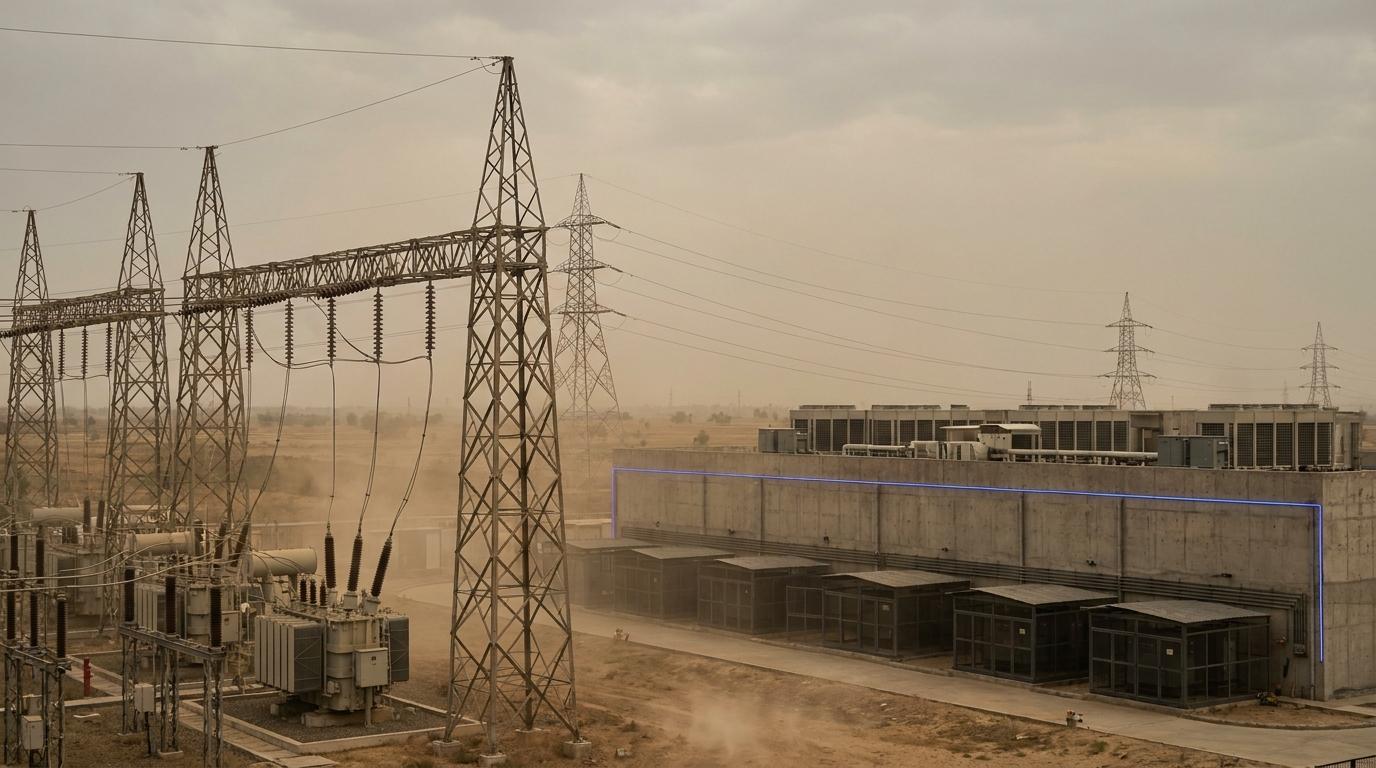
At 3:47 pm on 21 May 2026, India asked its grid for more power than it ever had: 270.82 GW. It was the fourth record in four days, after 257.37 GW, 260.45 GW and 265.44 GW. The Power Ministry put the surge down to cooling appliances. Some of that number was your air-conditioner.
Some of it was a building that has no afternoon. A data centre runs continuously, with what CEEW calls "near-zero tolerance for downtime". It was inside the 270.82. It will be inside every record after it, and the plan is for it to be a much bigger part of them.
The size of the load today
Small. CEEW's February 2026 white paper puts data centres at about 0.5 per cent of national electricity consumption in 2024. Wood Mackenzie puts their use at 10 TWh in 2025. India's total energy requirement in FY25 was about 1,694 TWh, per the Ministry of Power.
Spread 10 TWh across the 8,760 hours of a year and you get an average draw of about 1.1 GW. Against this May's peak, that is 0.4 per cent. (What a data centre megawatt is, and isn't, is explained here.)
The size of the load planned
Wood Mackenzie's July 2026 report projects India's operational data centre capacity rising from 2.2 GW in 2025 to 12 GW in 2030, of which AI-dedicated capacity goes from 275 MW to 6,546 MW. Electricity use goes from 10 TWh to 191 TWh by 2040, which it says would be 7 per cent of national demand.
India data centre capacity, Wood Mackenzie projection
MW
- All capacity, 2025
- All capacity, 2030projection
- AI-dedicated, 2025
- AI-dedicated, 2030projection
Run the same arithmetic on 191 TWh: about 21.8 GW of round-the-clock load. That is 8 per cent of this May's record, present in every hour of every day. Other houses are lower; IEEFA's 2025 estimate was 9 GW of capacity and about 3 per cent of electricity by 2030. Nobody's projection is small.
“Land and capital are no longer the limiting factors for data centre developers in India. What determines site selection and delivery timelines now is access to firm, round-the-clock power at the node level.”
— Rashika Gupta, Vice President of Research, Wood Mackenzie, 27 July 2026Why it lands at the expensive hour
Read the peak closely. On 21 May, demand stayed above 260 GW for about three hours, between 2 pm and 5 pm, according to Down To Earth's reading of Ministry of Power data. The shortage during solar hours was 0.18 GW. After sunset it was 2.57 GW, and coal generation rose from 171.7 GW at the peak to a maximum of 184.9 GW once solar faded. The hardest hour is when the sun leaves. A flat load is there then too. Exchange prices noticed: the day-ahead average on IEX in May was ₹4.88 a unit, up 18.3 per cent on a year earlier.
India's all-time peak electricity demand
GW
- FY14
- FY19
- FY23
- FY24
- FY2530 May 2024, Ministry of Power
- 21 May 2026Ministry of Power
Operators care about that price. CEEW, citing DCD, puts energy at 60 to 70 per cent of a data centre's operating cost. But their contracts care more about uptime. CEEW's interviews found that "even microsecond-scale power disturbances" can trigger penalties, so UPS and diesel gensets are treated as an "inherent design requirement".
Then the rulebook. The Central Electricity Authority's Manual on Transmission Planning Criteria, in force from 15 October 2026, lists data centres as critical loads that "shall plan their interconnection with the grid, with 100% redundancy", from two sources where possible. For every megawatt of campus, the plan carries two megawatts of connection.
And no market pays a data centre to bend. CEEW names the gap: no clearly priced ancillary services and limited revenue-stacking for storage. So every gigawatt of compute is contracted as firm demand, at peak, with a spare. That is the most expensive way to add it.
The discom's side of the bill
The cheaper electrons come from elsewhere. KPMG counts more than 3 GW of renewable PPAs announced by data centre operators, about 15 per cent of all such PPAs in India. CEEW describes the structure: full-capacity grid connections from the discom for reliability, with part of the demand met through open access, captive or group captive renewables.
The discom plans for the peak it has promised and sells less than it planned for. CEEW's words: "under-utilised or stranded capacity", fixed costs socialised "among other consumers", and pressure on discoms to discourage the very renewable procurement the government promotes. Operators, for their part, list cross-subsidy surcharges, additional surcharges and withdrawn waivers as their top regulatory frictions.
Maharashtra contributed the most to the 21 May peak, 31.5 GW. It is also home to Mumbai, which on CBRE's count holds more than half of India's operational data centre stock. The trap and the cluster are in the same state.
Storage is the exit. CEEW's interviewees expect batteries to become central to data centre power design in three to five years, and say about 80 per cent renewable supply is feasible with diversified solar, wind and storage; 24/7 on 100 per cent renewables remains "technically challenging". Water is the other bill (the building that drinks).
What the numbers don't tell you
How much of the 270.82 GW was data centres. Nobody publishes it; national dispatch data does not break the load out, and the 0.5 per cent figure is itself an estimate that CEEW cites from a Cornell study. We found no public register of diesel capacity installed at Indian campuses. And the projections disagree with each other before they disagree with reality: Wood Mackenzie starts 2025 at 2.2 GW; CBRE, Vayam's house series, counted just over 1,700 MW at the end of that year.
What to watch: the CEA's draft Technical Standards for Connectivity to the Grid, whose comment window closed on 2 September 2026; and the first Indian data centre paid by the grid for flexibility rather than charged for firmness.
Sources 17
- India's power consumption grows 11.55% to 164.98 billion units in May — The Hindu (PTI), 2026-06-01
- India's peak power demand hits record 270GW as temperature soars — Mint, 2026-05-21
- Power Demand Tracker: India meets all-time high demand of 270.8 GW — Down To Earth, 2026-05-22
- India records all-time high power demand, govt assures adequate coal stocks — Moneycontrol, 2026-05-25
- India's peak power demand hits record 270.82 GW in May; electricity traded on IEX rises 19% — ETEnergyWorld, 2026-06-04
- Load Generation Balance Report 2024-25 — Central Electricity Authority, 2024
- Lok Sabha reply on peak demand FY 2024-25 — PIB, Ministry of Power, 2025-03-27
- Rajya Sabha Unstarred Question 4147: Peak power demand and supply adequacy — Ministry of Power, 2026-03-30
- Scaling India's Data Centre Ecosystem: Stakeholder Perspectives on Infrastructure, Energy, and Resilience — CEEW, 2026-02
- India data centre capacity to reach 12 GW by 2030 — Wood Mackenzie, 2026-07-27
- India data centre capacity to jump to 12 GW by 2030 as AI fuels demand: Wood Mackenzie — The Economic Times, 2026-07-27
- India's power-hungry data centre sector at a crossroads — IEEFA, 2025-06-06
- India data centre opportunity: from emerging demand hub to integrated data centre powerhouse — KPMG in India, 2026-07
- Manual on Transmission Planning Criteria, 2026 — Central Electricity Authority, 2026-10-15
- CEA brings 1,150 kV into transmission planning, makes data centres, hospitals critical loads — PSU Watch / Energy Watch, 2026-10-16
- India data centre capacity to jump 30% in 2026: CBRE report — Business Today, 2026-04-01
- Draft CEA (Technical Standards for Connectivity to the Grid) Regulations, 2026: public notice — Central Electricity Authority, 2026-08
Every figure in this piece, and where it comes from 21 checked ↓
- Peak demand record 270.82 GW on 21 May 2026, after 257.37 (18 May), 260.45 (19 May) and 265.44 GW (20 May) — source
- Peak occurred at 3:47 pm on 21 May 2026, per National Power Portal data — source
- Power Ministry linked the surge to greater usage of cooling appliances — source
- Demand above 260 GW for about three hours, 2-5 pm; shortage 0.18 GW solar hours vs 2.57 GW non-solar; coal 171.7 GW at peak, up to 184.9 GW; Maharashtra 31.5 GW — source
- IEX day-ahead average price in May 2026 Rs 4.88/unit, up 18.3% YoY — source
- CEA peak demand series: FY14 135,918 MW; FY19 177,022; FY23 215,888; FY24 243,271 — source
- FY25 all-India peak demand 2,49,856 MW on 30.05.2024 — source
- FY25 total energy requirement about 16,93,959 MU — source
- CEEW: data centres ~0.5% of national electricity consumption in 2024 (citing Cornell 2025) — source
- CEEW: energy is typically 60-70% of DC operating cost (citing DCD 2025); microsecond disturbances trigger penalties; UPS and DGs an inherent design requirement — source
- CEEW: full-capacity discom connections plus open access/captive RE can strand discom capacity and socialise fixed costs; CSS, AS and withdrawn waivers top frictions — source
- CEEW: BESS central in 3-5 years; lack of priced ancillary services and revenue stacking a barrier; ~80% RE feasible; 24/7 100% RE technically challenging — source
- Wood Mackenzie: capacity 2.2 GW (2025) to 12 GW (2030); AI-dedicated 275 MW to 6,546 MW; electricity 10 TWh (2025) to 191 TWh (2040), 7% of demand — source
- Rashika Gupta, Wood Mackenzie, quote on firm round-the-clock power at the node level — source
- IEEFA (June 2025): capacity 1.4 GW to 9 GW by 2030, about 3% of India's electricity — source
- KPMG: 3+ GW RE PPAs announced by data centre operators, ~15% of total RE PPAs — source
- CEA Manual on Transmission Planning Criteria 2026, effective 15 Oct 2026: data centres critical loads, 100% redundancy, two sources where possible — source
- Data centres newly added to the critical-loads list; the 2023 manual's list ended at smelter plants — source
- Mumbai holds over 50% of India's operational DC inventory as of end-2025 (CBRE); CBRE stock just over 1,700 MW at end-2025 — source
- CEA draft Technical Standards for Connectivity to the Grid Regulations 2026; comments due 02.09.2026 — source
- Vayam arithmetic: 10 TWh / 8,760 h = ~1.1 GW; 191 TWh / 8,760 h = ~21.8 GW; 1.1/270.82 = 0.4%; 21.8/270.82 = 8% — source
In this story 2
Ganak — “the one who counts”
Dry, exact, faintly amused: every sentence carries a number, and every number names its source and its denominator.
More from the desk
AI & Data Centers →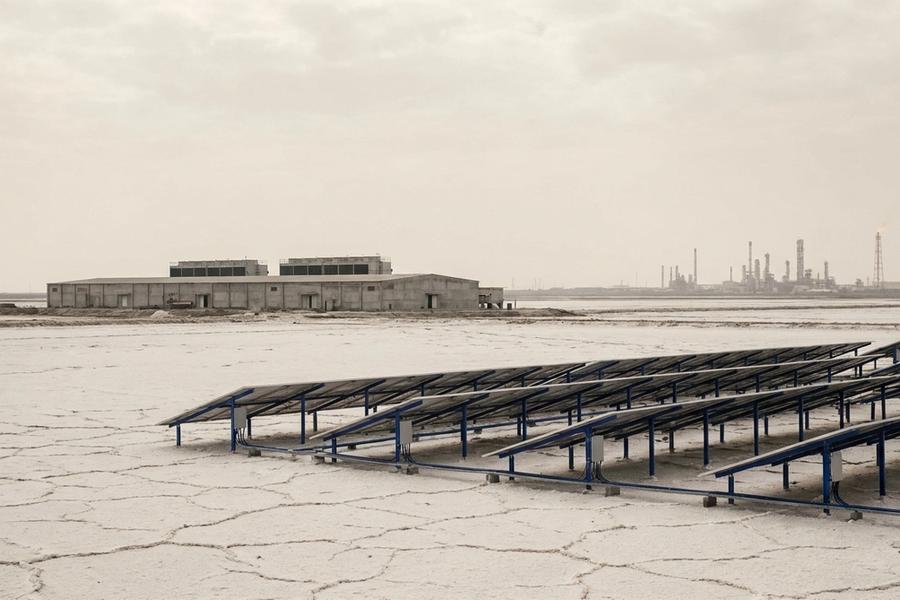
Jamnagar: why Reliance is building India's AI backbone next to its refinery
A quarter of India's refining capacity sits in one Reliance fence. Now the same site is promised 120 MW of AI compute by December, on solar power that has not yet arrived.
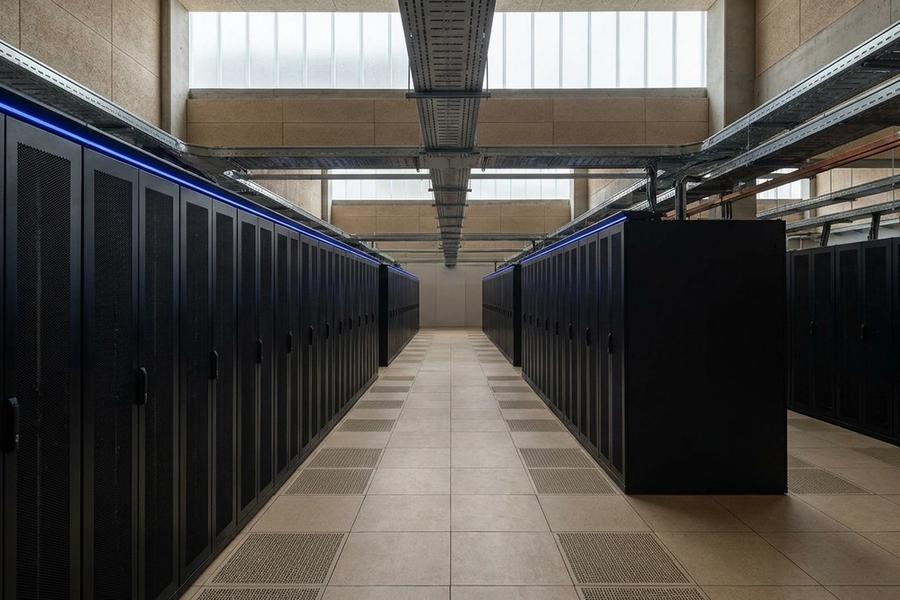
What is a megawatt of data centre? A field guide to MW, PUE, Tiers and GPU-hours
MeitY says India has about 1,575 MW of data centres. CBRE says it is heading for 2 GW. Both are right. Here is what every word in those headlines is actually counting.
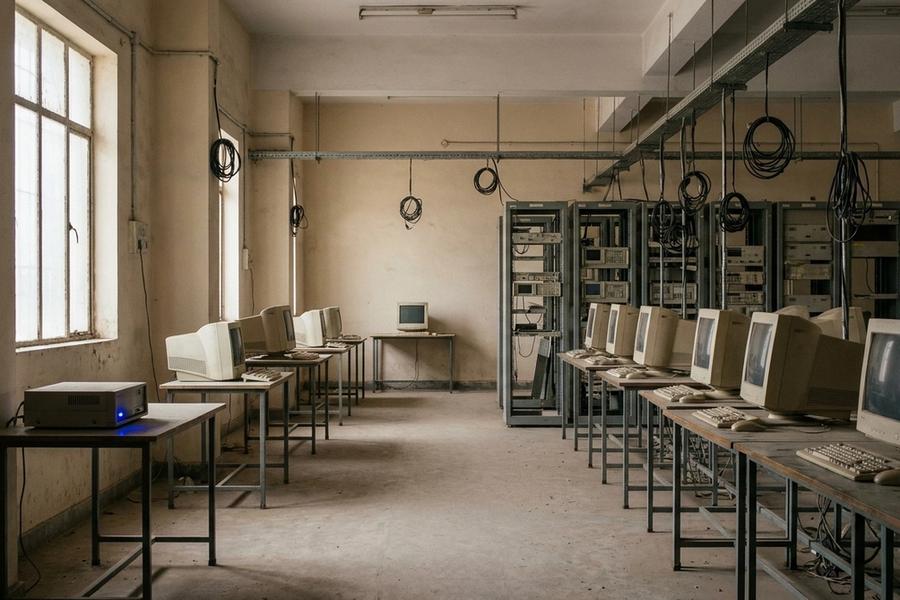
Online before China? The 1995 boast, and the state decisions behind India's data centres
VSNL's Independence Day internet was not first in Asia. What it began was a chain of state choices, from STPI's earth stations to RBI's data rule, that private capital has filled ever since.