India can write its own AI. It cannot yet make the thing that runs it
Sarvam and BharatGen trained Indian models on Indian soil. Underneath them sits imported silicon, and the terms of import are written in Washington. A floor-by-floor walk through India's AI stack.
The short version · five beatsOpen ↓Close ↑
- AnchorAn Indian AI assistant answers your question in Marathi, on a model trained from scratch in India.
- CrackThe government's own press release concedes the GPUs it ran on are 'primarily manufactured in one country'.
- MachineAccelerators from American firms, fabricated in Taiwan; packaging begun at Sanand; the Dholera fab at 28 nm and up, due mid-2028; a 38,000-GPU state pool; Sarvam and BharatGen models on top; US export rules redrafted and withdrawn.
- The truthThe models are ours; the ceiling isn't. The dependency moved from software to silicon, and access rests on policy, not on a treaty.
- Send-lineIndia can write its own AI. It cannot yet make the thing that runs it.
You type a question in Marathi into Indus, the assistant that Bengaluru's Sarvam AI runs on its 105-billion-parameter model. The answer comes back in Marathi. The model was trained from scratch, in India, on compute paid for partly by the Indian government. Everything about that exchange says made here.
Now ask a different question: what did the thinking happen on?
The government has already answered it, in a single line in a March 2026 press release about its own AI mission: "GPUs are highly advanced equipment and are primarily manufactured in one country." It did not name the country. It did not need to.
Think of it as a five-storey building
Here is the one picture to hold for the rest of this piece. Indian AI is a building with five floors. At the top, where you live, are the models that answer you. Below them, the data centre halls and the public pool of rented computing inside them. Below that, the fab that prints chips. Below that, the plants that package them. And at the ground floor, holding everything up, is the accelerator: the chip that does the arithmetic.
India has built, or is building, every floor of this building. The question is which floors it owns and which it leases. We will walk up from the ground.
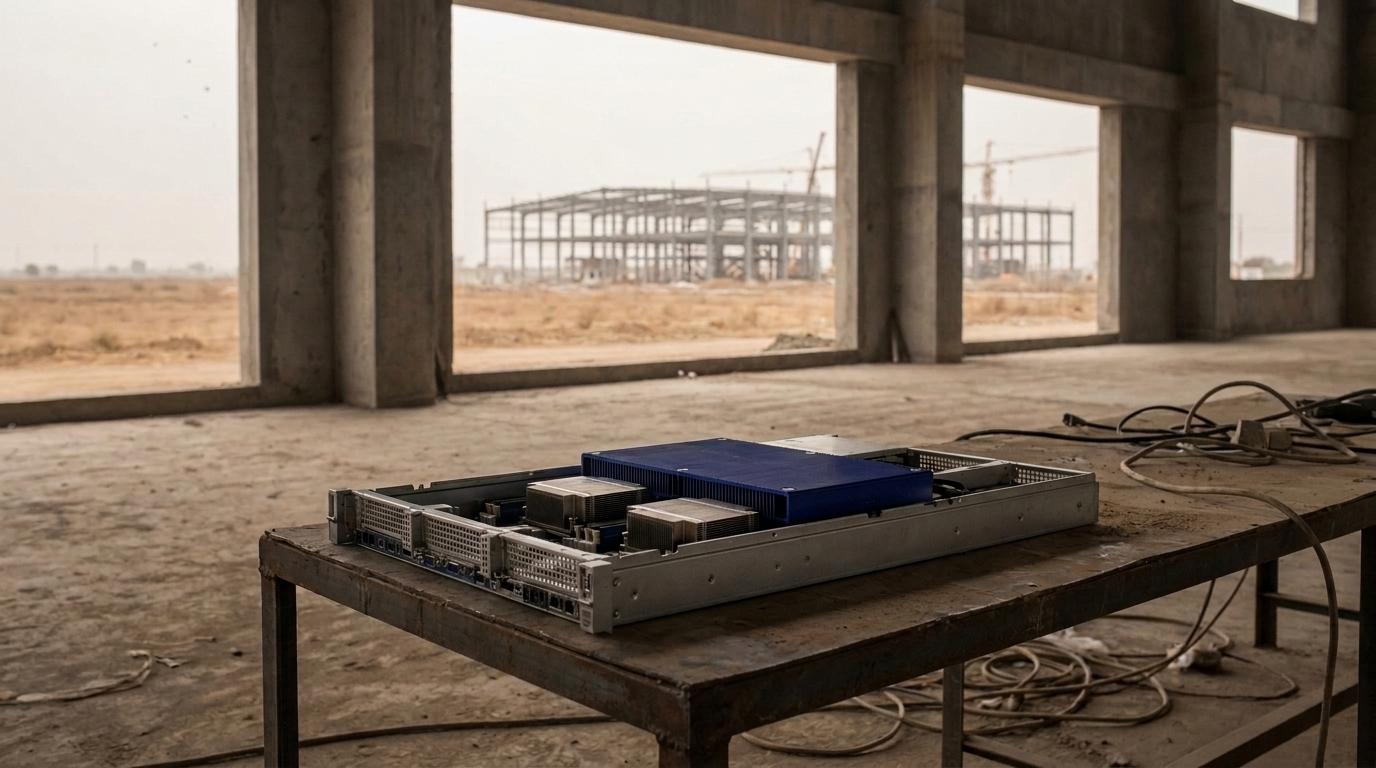
Ground floor: the accelerator, which India designs around but does not make
An accelerator is a chip built to do one kind of maths, the multiplication of huge grids of numbers, far faster than an ordinary processor can. A GPU (graphics processing unit) is the most common type. Large language models are trained on thousands of them working at once.
Look at the price list of the government's own GPU pool: every accelerator on it comes from an American company, NVIDIA, AMD, Intel, Amazon or Google. NVIDIA's chips are fabricated by Taiwan's TSMC, which Bloomberg describes as the go-to chipmaker for NVIDIA and as earning most of its revenue from processes of 5 nanometres and smaller.
India's position on this floor is real but specific. Electronics minister Ashwini Vaishnaw says 2-nanometre chips are already designed in India, though not fabricated here. An Indian AI accelerator is still a research programme: the government's own account says projects to design processors, general-purpose GPUs and accelerators under the National Supercomputing Mission, on the open RISC-V architecture, "have been initiated".
First floor: packaging, where India has started
A finished chip is two jobs. A fab prints the circuits onto a silicon wafer. A packaging plant, called an ATMP or OSAT, cuts the wafer into chips, seals each in a protective housing and tests it. The second job is easier, and it is the one India has begun.
Micron's plant at Sanand, Gujarat, went into commercial production on 28 February 2026. Its chief executive told an audience in September that it would process tens of millions of chips this year and hundreds of millions in 2027. But note what it receives: DRAM and NAND memory wafers from Micron's global manufacturing network. The silicon arrives; the finishing happens here.
Tata's packaging plant at Jagiroad, Assam, is not yet in commercial production. Mint reported this month that it is slated to start in December.
Second floor: the fab, where the floor is still being poured
India's first commercial fab is Tata Electronics' plant at Dholera, Gujarat, built with Taiwan's Powerchip (PSMC). The government lists it at ₹91,526 crore, with a capacity of 50,000 wafer starts a month on nodes from 110 nm down to 28 nm. A "node" is the generation of the manufacturing process; the smaller the number, the newer and denser the chip.
Two things have shifted since the plant was announced. In July, Vaishnaw said commercial operations are now expected in mid-2028, against an earlier target of end-2026. And Bloomberg reported, citing unnamed people, that the plant would start mostly on 90 nm. Tata's spokesperson said the plan "was always to start with 55nm and 90nm, followed by 28nm".
Hold that next to the ground floor. The foundry that makes NVIDIA's chips earns most of its money at 5 nm and below. Dholera's ceiling is 28 nm. That is not a failure: 28 nm chips run cars, phones and telecom gear, and the new Semicon 2.0 programme approved in July funds research on a 7-to-3 nm path. It means the fab India is building makes the chips around the computer, not the chip at its centre. This decade, Dholera does not touch the ground floor.
Third floor: the halls and the public pool
Above the factories are the data centre halls, the buildings full of power and cooling that host the chips. What one of them consumes in power and water is its own story (what is a megawatt of data centre).
Inside those halls, the government runs something unusual: a GPU pool. Rather than buy chips, the IndiaAI Mission empanels private operators and pays part of the bill for startups, researchers and agencies. In March it counted 38,231 GPUs from 14 providers, at an average of about ₹65 per GPU per hour. By July it had 15 providers and said access was available at under one US dollar an hour. The economics of the pool are in our data brief (the state as compute wholesaler).
One line in the pool's public ledger is Sarvam's: 4,096 NVIDIA H100 chips at Yotta's data centre, a bill of about ₹246.7 crore, of which the state covered about ₹98.7 crore. An Indian company, in an Indian operator's hall, on an Indian subsidy, running American-designed silicon.
Top floor: the models, which are ours
And at the top, the part you touched. Sarvam open-sourced its 30B and 105B models on 6 March 2026, saying training "was conducted entirely in India on compute provided under the IndiaAI mission", with NVIDIA contributing software libraries. A large share of the training budget went to the ten most-spoken Indian languages. BharatGen, the IIT Bombay-led consortium backed by ₹1,058 crore from the IndiaAI Mission, released Param-2, a 17-billion-parameter model in 22 scheduled languages.
These are not wrappers on someone else's model. The weights, the data choices and the engineering are Indian. On the top floor, India owns the flat.
Who holds the lease on the ground floor
So who decides whether more accelerators arrive? Mostly, the US Commerce Department, through export controls: rules on which chips can be shipped where, and with whose permission.
In January 2025 the outgoing Biden administration published the "AI Diffusion" rule, which sorted the world into three tiers. India sat in the middle tier, facing a cap of roughly 50,000 advanced AI chips through 2027. That rule never took effect. On 13 May 2025, two days before compliance was due, Commerce rescinded it and promised a replacement "in the future". If you have read that India is capped at 50,000 chips, you have read about a rule that is dead.
The replacement has not arrived. In March 2026 Reuters reported a draft under which even installations of under 1,000 chips could need a licence, and countries seeking 200,000 or more might have to invest in American AI data centres or give security guarantees. Eight days later Commerce withdrew a planned rule. In February, India signed the US-led Pax Silica declaration on secure chip and AI supply chains. Business Today, reporting on the separate US-India interim trade agreement that month, noted that India faces no export restrictions on advanced AI chips today. One analyst it quoted put the limits of that reassurance precisely:
“It suggests policy stability, not a legally binding commitment.”
— Manish Rawat, TechInsights, to Business Today, 11 February 2026What the terms look like when Washington does write them is visible in the Gulf. In July, Commerce let the UAE government and approved companies receive AI chips licence-free, noting the UAE had reaffirmed its commitment to make "matching investments" in US AI infrastructure. This month Nazak Nikakhtar, a former acting head of Commerce's export-control bureau, said licences to the UAE and Saudi Arabia were being held while Washington waits for their investment promises to move.
So the honest answer, as of October 2026: there is no fixed cap on India today, and NVIDIA and AMD chips are sold here legally. But access rests on policy, not on a treaty, and policy is drafted, withdrawn and redrafted in Washington on its own clock. India does not hold the lease on the ground floor. It has a good relationship with the landlord.
The government has already priced this in
None of this is hidden from New Delhi. The Economic Survey 2025-26 states it plainly: "India's access to cutting-edge compute infrastructure is limited." In a modelling exercise, the Survey's simulated data centre operators pile up in a "waiting for GPUs" state even when money and demand are plentiful. Its answer is what it calls a frugal AI pathway: small, task-specific models that run on phones and laptops, which need fewer of the chips India cannot make.
That is a sensible bargain with a constraint. It is also an admission of where the constraint sits. The dependency did not disappear when India learnt to train its own models. It moved down the building, from software to silicon.
What we don't know
We do not know what the next US chip rule will say, or when it will come. We do not know when, or whether, Dholera's 28 nm line will run at volume. And we have found no public count of how many GPUs in Indian data centres belong to Indian owners, as against foreign cloud companies.
So the next time an Indian model answers you in your own language, ask the question behind the answer: whose permission did the chip under it need, and who could take that permission back?
Sources 21
- Open-sourcing Sarvam 30B & 105B models — Sarvam AI, 2026-03-06
- Semicon India Programme Boosts Domestic Chip Manufacturing and Design Ecosystem — PIB / MeitY, 2026-03-25
- Government supporting organisations and consortia to develop sovereign foundational model — PIB / MeitY, 2026-03-25
- Lok Sabha Unstarred Question 1812: Access of GPUs under the IndiaAI Compute Portal — MeitY / Sansad, 2026-07-29
- IndiaAI Compute Capacity — GPU allocation ledger — IndiaAI, 2025
- IndiaAI Cloud Computing Portal — price list — IndiaAI, 2026
- Minister lauds India's first government owned sovereign LLM (BharatGen) — PIB, 2026-02-17
- Tata Group resorts to older tech to launch its chip foray (Bloomberg) — ET Manufacturing, 2026-07-18
- Tata's India fab reportedly to launch at 90nm instead of 28nm — TrendForce, 2026-07-20
- Cabinet clears Rs 1.9 lakh crore for chip & mobile manufacturing — ThePrint, 2026-07-16
- Semicon India 2026: Micron, Tata, Infineon outline next steps — The Times of India, 2026-09-17
- Tata's Assam chip unit is almost ready — Mint, 2026-10-05
- New US AI export rule excludes India from benefits of closest allies — The Indian Express, 2025-01-15
- Department of Commerce Announces Rescission of Biden-Era AI Diffusion Rule — US Bureau of Industry and Security, 2025-05-13
- US mulls new rules for AI chip exports, including requiring US investments by foreign firms — Reuters, 2026-03-05
- US Commerce Department withdraws planned rule on AI chip exports — Reuters, 2026-03-13
- United States and India Sign Pax Silica Declaration — US Department of State, 2026-02-20
- Geopolitics of GPUs: How the US India interim deal shields New Delhi's AI ambitions — Business Today, 2026-02-11
- Department of Commerce Eases Export Controls for UAE — US Bureau of Industry and Security, 2026-07-10
- Former BIS Official: Chip Licenses Being Held Until UAE, Saudis Follow Through on Investments — Export Compliance Daily, 2026-10-19
- Economic Survey 2025-26, Chapter 14: Evolution of the AI Ecosystem in India — Ministry of Finance, 2026-01-29
Every figure in this piece, and where it comes from 25 checked ↓
- Sarvam 105B powers Indus; training 'was conducted entirely in India on compute provided under the IndiaAI mission'; open-sourced 6 March 2026 — source
- Sarvam's multilingual corpus allocates a substantial share of training to the 10 most-spoken Indian languages; NVIDIA contributed libraries — source
- 'GPUs are highly advanced equipment and are primarily manufactured in one country' (PIB, 25 Mar 2026) — source
- NSM projects to design processors, GPGPUs and accelerators on RISC-V 'have been initiated' — source
- Tata fab in Gujarat: ₹91,526 crore, nodes 110 nm to 28 nm, 50,000 wafer starts per month — source
- Every accelerator on the IndiaAI compute price list is from NVIDIA, AMD, Intel, AWS or Google — source
- TSMC is the go-to chipmaker for NVIDIA and earns most revenue from 5 nm and smaller (Bloomberg via ET) — source
- Dholera to start mostly on 90 nm (Bloomberg, unnamed sources); Tata: 'start with 55nm and 90nm, followed by 28nm'; commercial ops mid-2028 (Vaishnaw) — source
- 28 nm is the most advanced node in the PSMC partnership (PSMC spokesperson) — source
- 2-nm chips designed in India, not fabricated here; Semicon 2.0 R&D pillar targets a 7–3 nm path; Micron Sanand commercial from 28 Feb 2026 — source
- Micron Sanand: tens of millions of chips this year, hundreds of millions in 2027; receives DRAM and NAND wafers from its global network — source
- Tata's Jagiroad OSAT slated to start production in December — source
- 38,231 GPUs onboarded from 14 providers; average about ₹65 per GPU per hour (Mar 2026) — source
- 15 compute providers empanelled; GPU access under USD 1 per hour with subsidies up to 40% (Lok Sabha, 29 Jul 2026) — source
- Sarvam allocation: 4,096 H100 SXM at Yotta; bill ≈₹246.7 crore; subsidy ≈₹98.7 crore — source
- BharatGen Param-2: 17B parameters, 22 scheduled languages; ₹1,058 crore from IndiaAI Mission; consortium led from IIT Bombay — source
- AI Diffusion rule (Jan 2025): India in middle tier, cap roughly 50,000 advanced AI chips through 2027 — source
- Commerce rescinded the AI Diffusion rule on 13 May 2025, two days before compliance; replacement 'in the future' — source
- March 2026 draft: under-1,000-chip installations could need licences; 200,000+ could require US investment or security guarantees — source
- Commerce withdrew a planned AI chip export rule on 13 March 2026 — source
- India signed the Pax Silica Declaration on 20 February 2026 — source
- India faces no export restrictions on advanced AI chips today; Rawat: 'policy stability, not a legally binding commitment' — source
- July 2026: UAE government and certain firms approved to receive AI chips licence-free; UAE reaffirmed 'matching investments' — source
- Nikakhtar (ex-acting BIS under secretary): licences to UAE and Saudi Arabia 'are being held' pending investments — source
- Economic Survey 2025-26: 'India's access to cutting-edge compute infrastructure is limited'; simulated operators stuck 'waiting for GPUs'; frugal AI pathways — source
In this story 9
Sutradhar — “the one who holds the thread”
Patient and warm: from the thing you are holding to the system behind it, with one sustained analogy and every term defined the first time.
More from the desk
AI & Data Centers →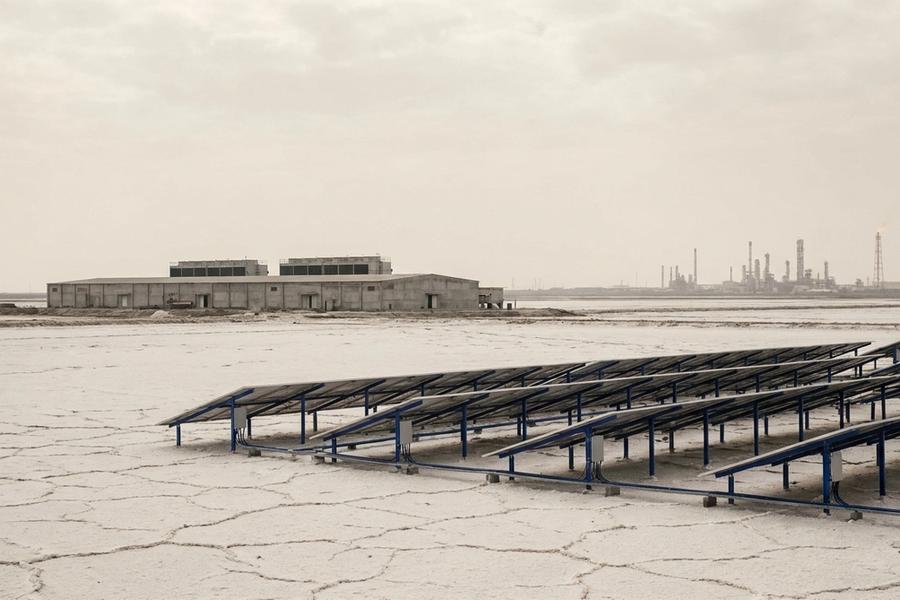
Jamnagar: why Reliance is building India's AI backbone next to its refinery
A quarter of India's refining capacity sits in one Reliance fence. Now the same site is promised 120 MW of AI compute by December, on solar power that has not yet arrived.
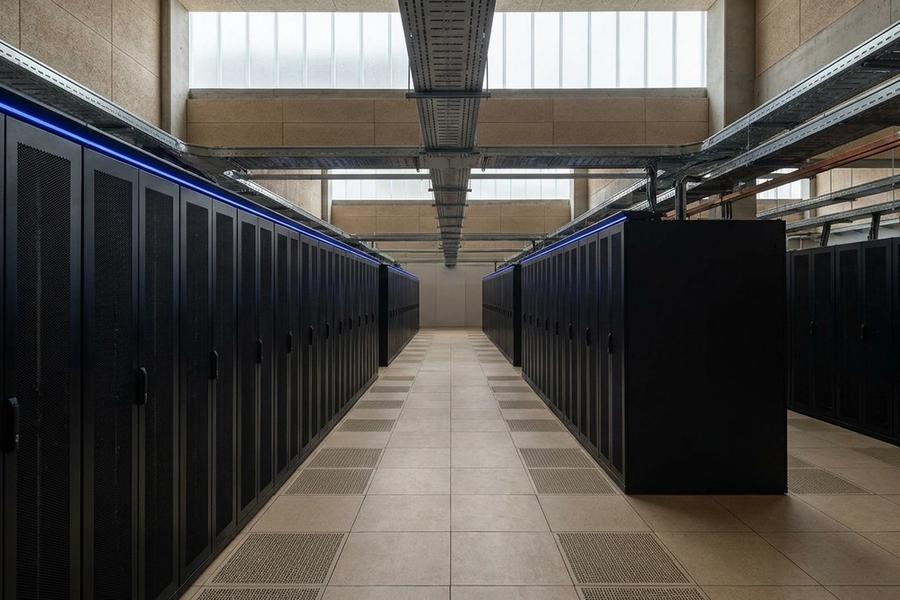
What is a megawatt of data centre? A field guide to MW, PUE, Tiers and GPU-hours
MeitY says India has about 1,575 MW of data centres. CBRE says it is heading for 2 GW. Both are right. Here is what every word in those headlines is actually counting.
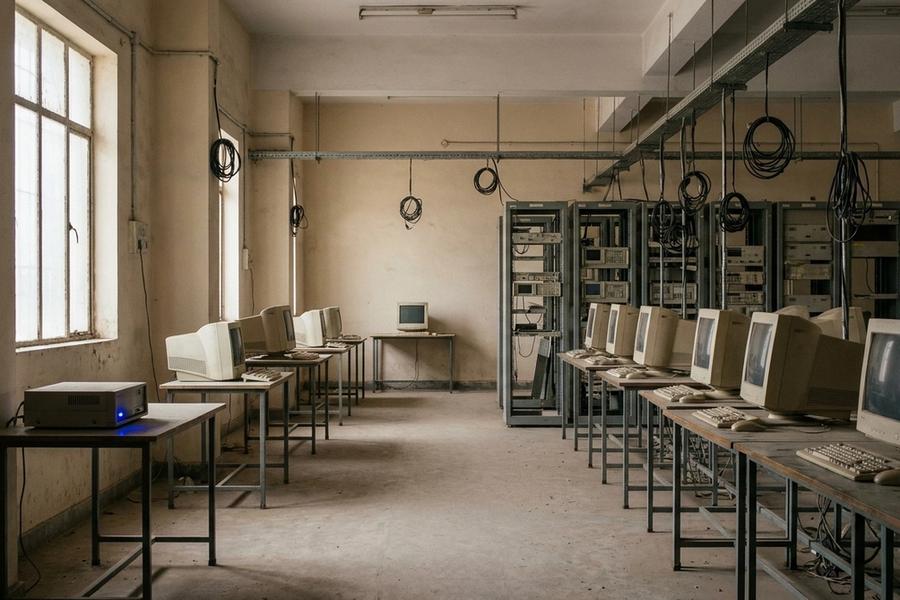
Online before China? The 1995 boast, and the state decisions behind India's data centres
VSNL's Independence Day internet was not first in Asia. What it began was a chain of state choices, from STPI's earth stations to RBI's data rule, that private capital has filled ever since.