Why India's data centres live by the sea
Thirteen of India's eighteen international cables come ashore on one six-kilometre stretch of Mumbai. The compute followed the cables, and the next landings are on the east coast.
The short version · five beatsOpen ↓Close ↑
- AnchorA reel that loads instantly; a video call to a cousin in Dubai.
- CrackThat data almost certainly crossed a beach, and most likely one six-kilometre stretch of Versova.
- MachineSubsea cables, cable landing stations in five cities, latency at ~5 µs per km of fibre, data centres clustered beside the landings, and new systems (IEX, SEA-ME-WE-6, 2Africa, Raman, I-2SEA) redrawing the map.
- The truthIndia's AI map is being drawn by where cables come ashore, and nearly all of them still come ashore in one city.
- Send-lineIndia's AI map is being drawn wherever a cable crawls out of the sea.
You tap a reel and it plays before your thumb has left the glass. You call a cousin in Dubai and her face arrives in step with her voice. Neither feels like geography. Both are.
Somewhere between your phone and that video, the data almost certainly crossed a beach. If it came from Europe, the Gulf or Africa, the odds are high that it crossed one particular beach in north-west Mumbai. That beach, and a handful like it, are quietly deciding where India builds the buildings that run its AI.
Six kilometres of sand
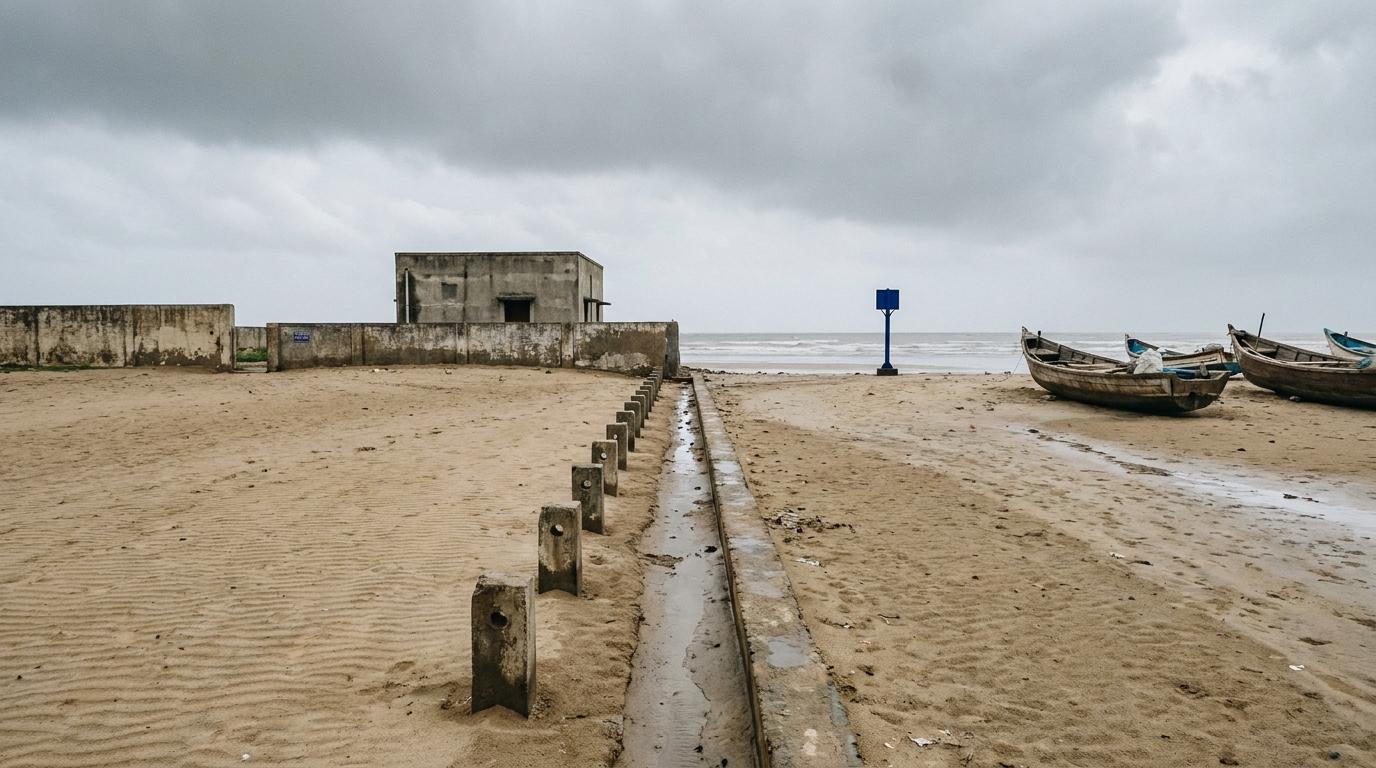
Start at Versova, on Mumbai's Arabian Sea coast. The BBC reported in September that at least 13 of India's 18 intercontinental submarine cables come ashore within six kilometres of one another around this neighbourhood, carrying as much as 95% of India's international bandwidth to Europe, Africa and West Asia.
A submarine cable is a bundle of optical fibres, armoured and laid on the seabed, carrying data as pulses of light. Where it meets land it enters a cable landing station: a guarded building near the shore where the undersea system hands traffic to the terrestrial network. Reliance Jio's AAE-1 station sits on Versova beach, and Global Cloud Xchange runs the Versova station for its FALCON cable, according to Submarine Networks, an industry reference site.
Pan along the coast and the list is short. India's international cables land in five cities: Mumbai, Chennai, Kochi, Thoothukudi (Tuticorin) and Thiruvananthapuram, per the government's own count. At the end of 2025, TRAI chairman Anil Kumar Lahoti said the country hosted 18 international cables across 23 distinct landings, with lit capacity up 60% in a year to 309 terabits per second.
Set that against demand. India accounts for roughly 20% of the world's data consumption but connects to about 3% of the world's submarine cables, the BBC reports, and the Broadband India Forum counts 21 Indian landing stations against roughly 1,900 planned and active worldwide.
Why distance is a product
Light in a glass fibre travels at roughly two-thirds of its speed in a vacuum, about 200,000 kilometres a second. The networking community's working rule, set out by the European research network GÉANT, is about 5 microseconds of delay for every kilometre of fibre, one way. A thousand kilometres costs 5 milliseconds there and 10 milliseconds back, before a single router has touched the packet.
So distance is a line item. The India Europe Xpress cable runs about 9,775 km from Mumbai to Marseille. On that rule of thumb, the glass alone adds close to 49 milliseconds each way. A data centre that has to haul its traffic another 1,000 km overland to reach the beach adds 10 milliseconds to every round trip, for every user, forever. For a stock exchange, a cloud region or an AI model answering in real time, that is the difference between a product and a complaint.
This is why the industry clusters where it does. The Council on Energy, Environment and Water noted in February that most hyperscaler data centres in India sit in coastal Mumbai and Chennai, close to the landing stations. The government's own table, tabled in the Lok Sabha on 18 March 2026 from industry sources, lists Mumbai and Navi Mumbai at 790 MW and Chennai at 305 MW of operational capacity. On our arithmetic, that is about 72% of the 1,520 MW in the table, sitting in the two cities where the cables come ashore.
The new cables are still landing in the old places
The pipeline tells you the map is being redrawn, slowly. In the same March answer, MeitY listed four systems under commissioning: India Europe Xpress (Reliance Jio, Mumbai), SEA-ME-WE-6 (Bharti Airtel, Mumbai and Chennai), 2Africa (Bharti Airtel, Mumbai) and the Raman cable (Sify, Mumbai). Three more were in planning: Tata Communications' Wyasa in Chennai, Jio's Indian Ocean Cable at Raigad, and Sify's WABAN in Mumbai.
Earlier, Jio's India Asia Xpress, which runs to Singapore with stops including Malaysia, Thailand, Sri Lanka and the Maldives, landed at Mumbai and Chennai, as the TRAI chairman also noted in February. Count the Indian ends of those seven systems. Of eight landings, five are in Mumbai, two in Chennai and one at Raigad, a short way down the same Konkan coast. New cables follow old cables, because the landing stations, the permissions and the paying customers are already there.
The east coast opens
The change is on the other sea. On 2 July 2026, Lightstorm signed contracts with Microsoft, Singtel and Tata Communications to build I-2SEA, a roughly 3,600 km cable from Singapore and Kuala Lumpur to India's east coast. Lightstorm describes it as purpose-built for AI training and inference traffic. It lands twice in India: at Machilipatnam in Andhra Pradesh, chosen as the shortest subsea access to Hyderabad's data centre cluster, and at a new, diverse landing in South Chennai. NEC is the supplier; the target date for service is the fourth quarter of 2029.
Follow the line inland from Machilipatnam and you reach Hyderabad, a city with 152 MW of capacity in MeitY's table and no coastline. Here the cable is being drawn to the compute, not the other way round. Lightstorm says customers will be able to ride its 30,000 km terrestrial network onward to Hyderabad, Mumbai and more than 80 data centres, which is the other half of the system: a landing station is only as useful as the fibre that leaves it. The Hindu reported that no investment figure was disclosed.
Further up the coast, Google has said its Visakhapatnam AI hub will include a new international subsea gateway, and in February it named the paths: direct routes from Vizag to Singapore, and from Vizag and Chennai towards South Africa, adding diversity to Mumbai and Chennai. The Visakhapatnam profile covers what that does to the city. On the west coast, Karnataka's new data centre policy flags Mangaluru for its port links and the potential for a cable landing station, The News Minute reports.
The sea as a radiator
The coast offers a second gift: a near-endless heat sink. A data centre turns electricity into heat, and getting rid of it costs either power or water. CEEW reports that coastal hyperscale sites in Mumbai and Chennai leverage seawater cooling, and that Andhra Pradesh's policy actively promotes it. The Institute for Energy Economics and Financial Analysis argues that coastal seawater can be used for cooling without desalination, and that every emerging Indian cluster except the National Capital Region lies within 300 km of the coast.
Which explains the exception. Reliance's Jamnagar campus is on the Gulf of Kutch but has no international cable landing; it was sited on energy logic, beside the refinery and the group's renewable build-out. Jio says its 168 MW Jamnagar facility will be cooled with desalinated seawater and run on renewable power. It uses the sea as a radiator, not as a doorway. The Jamnagar profile tells that story.
The fragile part
Concentration is a cost as well as a convenience. The BBC cites a Takshashila Institution paper finding that 11 of India's 18 international cables are more than 20 years old, close to the nominal 25-year life of a cable system. India has no domestic cable-repair ships; repair vessels come from abroad and need permission to work in Indian waters. Aruna Sundararajan, chair of the Broadband India Forum, told the BBC that a single landing station can need around 50 clearances across at least 16 ministries.
Breaks are routine, not exotic. The BBC puts global cable faults at an estimated 150 to 200 a year, most caused by fishing, ship anchors, natural hazards and equipment failure rather than sabotage. When the Red Sea routes were disrupted, Lightstorm's Amajit Gupta told the BBC, traffic was rerouted east through Singapore. A country with one dominant beach has fewer such detours.
The government has moved part of the way: DoT's Rudra Narayan Palai said in February that cable landing stations now hold the status of critical telecom infrastructure.
What to watch
The horizon runs along the east coast. Watch whether 2Africa and SEA-ME-WE-6 are declared ready for service in Mumbai and Chennai, whether Vizag's gateway names its cables and a date, and whether Machilipatnam is a working landing by the end of 2029. Next time a reel loads instantly, ask which beach it came through, and how many other beaches India has to fall back on.
Sources 16
- Is India's internet boom running into an undersea problem? — BBC News, 2026-09-03
- India seeks to create conducive environment for submarine cable investments, says TRAI's AK Lahoti — ETTelecom, 2026-02-24
- Lok Sabha answer: data centres and submarine cable systems — PIB / MeitY, 2026-03-18
- India's role in submarine cable infrastructure — PIB, 2024-12-05
- Propagation delay — GÉANT eduPERT knowledge base
- India Europe Xpress (IEX) — GeoCables, 2026-04
- Lightstorm, Microsoft, Singtel and Tata Communications launch the build of I-2SEA — Lightstorm, 2026-07-02
- Submarine cable system project linking India, Malaysia, Singapore unveiled — The Hindu, 2026-07-02
- Our first AI hub in India, powered by a $15 billion investment — Google, 2025-10-14
- Announcing America-India Connect — Google, 2026-02-18
- Scaling India's Data Centre Ecosystem — CEEW, 2026-02
- Blue seas and green electrons: Powering India's AI data centres — IEEFA
- India's data centres shift cooling strategy amid water crisis — The Hindu BusinessLine, 2026-06-23
- Karnataka's new data centre policy puts water, energy in focus — The News Minute, 2026-09-30
- Sri Lankan portion of India Asia Xpress subsea cable now operational — DCD, 2025-05-12
- India cable landing stations — Submarine Networks
Every figure in this piece, and where it comes from 25 checked ↓
- At least 13 of India's 18 intercontinental cables land within 6 km around Versova, carrying up to 95% of international bandwidth to Europe, Africa and West Asia — source
- Jio's AAE-1 landing station is at Versova beach; GCX owns the Versova station for FALCON — source
- International cables land in Mumbai, Chennai, Cochin, Tuticorin and Trivandrum — source
- TRAI chairman: 18 international subsea cables across 23 distinct landings at end-2025; lit capacity 309 Tbps, +60% YoY — source
- India ~20% of global data consumption, ~3% of world's submarine cables; 21 CLS vs ~1,900 globally (BIF) — source
- Propagation speed in fibre ~200,000 km/s; ~5 µs per km one way; 1,000 km = 5 ms one way, 10 ms round trip — source
- IEX is ~9,775 km, Mumbai to Marseille — source
- Most hyperscaler data centres in India are in coastal Mumbai and Chennai, proximal to landing stations, leveraging seawater cooling — source
- Lok Sabha 18.03.2026: Mumbai/Navi Mumbai 790 MW, Chennai 305 MW, Bengaluru 182, Hyderabad 152, Delhi-NCR 76, Others 15 (industry sources) — source
- Under commissioning (Mar 2026): IEX (Jio, Mumbai), SEA-ME-WE-6 (Airtel, Mumbai & Chennai), 2Africa (Airtel, Mumbai), Raman (Sify, Mumbai) — source
- Planned: Wyasa (Tata, Chennai), Indian Ocean Cable (Jio, Raigad), WABAN (Sify, Mumbai) — source
- IAX has landing stations in Chennai and Mumbai plus Malaysia, Maldives, Singapore, Thailand, Sri Lanka — source
- TRAI chairman: IAX has successfully landed at Mumbai and Chennai — source
- I-2SEA: contracts signed 2 July 2026 by Lightstorm, Microsoft, Singtel, Tata Communications; ~3,600 km; Machilipatnam + South Chennai; RFS Q4 2029; NEC supplier — source
- No investment details shared for I-2SEA — source
- Google's Vizag AI hub includes a new international subsea gateway — source
- America-India Connect: Vizag-Singapore path; Vizag and Chennai path to South Africa — source
- Karnataka policy identifies Mangaluru for port links and potential CLS infrastructure — source
- Andhra Pradesh promotes seawater cooling for coastal data centres — source
- IEEFA: coastal seawater can be used without desalination; all emerging clusters except NCR within 300 km of coast — source
- Jio's 168 MW Jamnagar data centre to be cooled with desalinated seawater, powered by renewables — source
- Global cable faults ~150-200 a year, mostly fishing, anchors, hazards, equipment; Red Sea traffic rerouted via Singapore (Gupta) — source
- Lightstorm 30,000+ km terrestrial network to Hyderabad, Mumbai and 80+ data centres — source
- Takshashila: 11 of 18 cables over 20 years old; no domestic repair ships; ~50 clearances across 16 ministries for a CLS (Sundararajan) — source
- DoT's Rudra Narayan Palai: CLSs accorded critical telecom infrastructure status — source
In this story 12
Yatri — “the traveller”
Map-minded and present-tense: moves across a place like a camera — coast, landing station, substation, field — and attributes every description to the record that contains it.
More from the desk
AI & Data Centers →
Jamnagar: why Reliance is building India's AI backbone next to its refinery
A quarter of India's refining capacity sits in one Reliance fence. Now the same site is promised 120 MW of AI compute by December, on solar power that has not yet arrived.
What is a megawatt of data centre? A field guide to MW, PUE, Tiers and GPU-hours
MeitY says India has about 1,575 MW of data centres. CBRE says it is heading for 2 GW. Both are right. Here is what every word in those headlines is actually counting.
Online before China? The 1995 boast, and the state decisions behind India's data centres
VSNL's Independence Day internet was not first in Asia. What it began was a chain of state choices, from STPI's earth stations to RBI's data rule, that private capital has filled ever since.