India Exports Weapons Now. Here’s Who’s Buying — and Why That Changes Everything
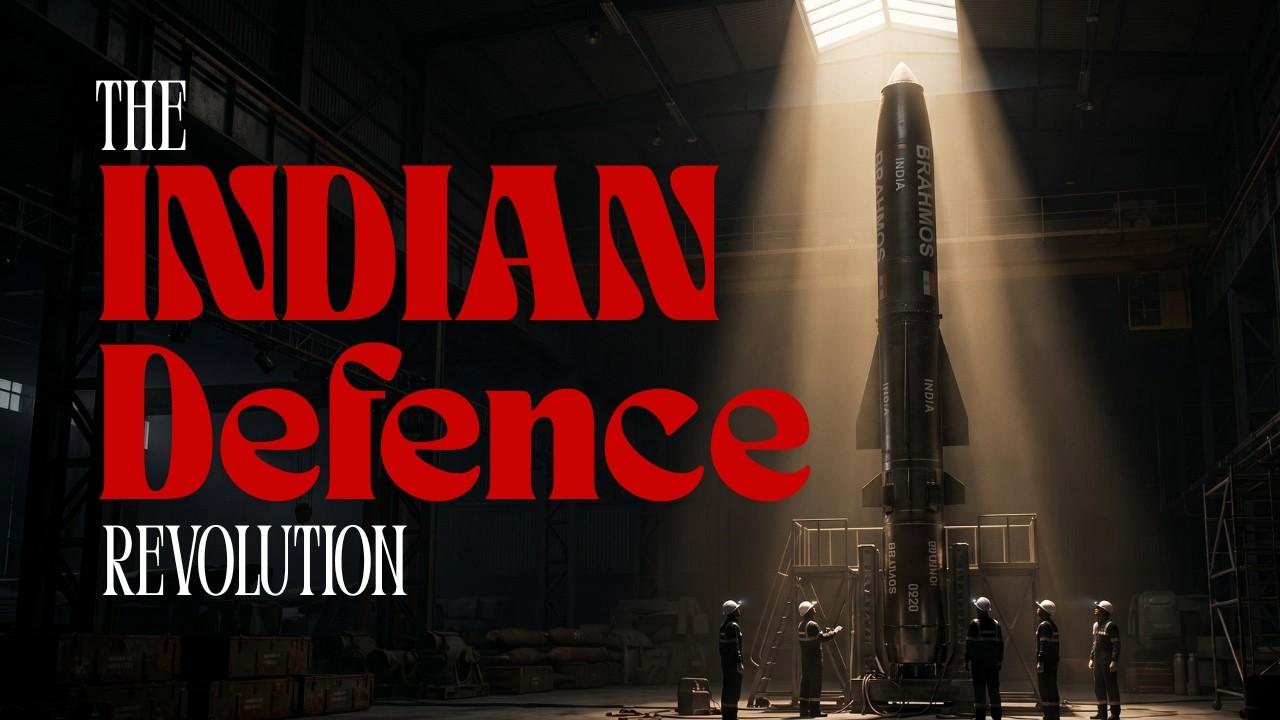
The short version · five beatsOpen ↓Close ↑
- AnchorIndia as an arms importer — the fact everyone grew up with.
- CrackIndia now exports BrahMos.
- MachineAn indigenisation push turning a buyer into a seller.
- The truthThe country that imported most of its arms a decade ago is now on the other side of the table.
- Send-lineIndia exports weapons now.
Fun fact to start: India's first major defence export customer in the modern era was Mauritius — a country with no military threat and a population smaller than Pune — that bought a Dornier maritime surveillance aircraft from HAL for coastal patrol. That single aircraft, flying lazy circles over the Indian Ocean looking for fishing violations, quietly marked the beginning of something that would take another decade to fully announce itself.
The Country That Couldn't Make Its Own Rifle
To understand what India's defence export story actually means, you have to start with how embarrassing the situation once was.
For the better part of independent India's history, the country was among the world's largest arms importers — sometimes the single largest. The Defence Research and Development Organisation (DRDO) was established in 1958 with great ambition. Hindustan Aeronautics Limited (HAL) had been building aircraft since 1940. And yet, decade after decade, India's armed forces continued to be equipped overwhelmingly with weapons bought from abroad — Soviet fighters, British submarines, French jets, American transport aircraft, Israeli drones, Russian tanks.
The Insas assault rifle, meant to be India's indigenous standard infantry weapon, was in development for so long and encountered so many problems that even after it was introduced, soldiers reportedly preferred older foreign alternatives. The Arjun Main Battle Tank took 37 years from concept to induction. The Tejas Light Combat Aircraft programme — launched in 1983 — did not achieve Initial Operational Clearance until 2011.
India was spending roughly $15–16 billion annually on defence imports by the early 2010s, making it the world's largest arms importer for multiple consecutive years according to SIPRI (Stockholm International Peace Research Institute) data. The country was buying bullets, artillery shells, and rifles from abroad. A nuclear-armed nation with a space programme and a steel industry that produces 140 million tonnes a year could not adequately arm its own soldiers from its own factories.
That was the baseline. What happened next is one of Indian industry's most consequential turnarounds.
The Number That Matters: ₹23,622 Crore in a Single Year
India's defence exports in FY2025 stood at ₹23,622 crore — approximately $2.8 billion. That is a 34-fold increase over FY2013-14, when exports were negligible.
To put that in industrial terms: this is not a rounding error or a diplomatic gift. This is a genuine manufacturing story. Indian defence companies are now shipping physical products — aircraft, radar systems, missiles, armoured vehicles, ammunition, sonar systems, ship components, electronics — to customers across multiple continents. The government has set a target of ₹50,000 crore ($6 billion) in annual exports by 2029.
The question is: how did this reversal happen? The answer involves policy architecture, private sector entry, institutional willingness, and — crucially — one very public proof-of-concept in May 2025.
Policy First: Three Changes That Unlocked Everything
The shift did not happen spontaneously. Three specific policy interventions created the conditions for Indian defence manufacturing to become export-capable.
The first was the liberalisation of the defence industrial licensing regime. Prior to 2014, producing defence equipment in India required navigating a system of licences, approvals, and FDI restrictions so complex that most private companies simply didn't bother. The foreign direct investment limit in defence was raised from 26% to 74% under the automatic route and 100% with government approval. Licensing requirements were simplified. Companies that had spent decades watching the sector from the outside — Tata, Mahindra, L&T, Bharat Forge, Godrej — began establishing defence manufacturing operations.
The second was the introduction of the 'Make in India' framework for defence, which created specific categories of procurement — Make I, Make II, Make III — designed to progressively reduce import content. More significantly, the government introduced a 'Strategic Partnership' model that paired Indian private companies with foreign OEMs for platform-level manufacturing. This meant that foreign companies wanting to sell to India's military increasingly had to manufacture in India, and in doing so, they built the domestic capability that eventually enabled exports.
The third was the creation of defence industrial corridors in Uttar Pradesh and Tamil Nadu in 2018. These corridors — the Bundelkhand Defence Industrial Corridor and the Tamil Nadu Defence Industrial Corridor — were designed to cluster defence manufacturers, reduce logistics costs, and create ecosystem effects. As of 2025, both corridors have attracted investments from over 200 companies and are producing components for multiple platforms.
The cumulative effect of these policies was to pull private Indian manufacturing into a sector that had been a government monopoly for 70 years.
What India Is Actually Selling
The export portfolio is more sophisticated than most people realise.
Brahmos cruise missiles are the flagship. Developed by BrahMos Aerospace, a joint venture between India's DRDO and Russia's NPO Mashinostroyeniya, the supersonic cruise missile flies at Mach 2.8 — roughly three times the speed of sound — and has a range of 290-500 km depending on the variant. The Philippines signed a $374 million deal in 2022 for three shore-based Brahmos batteries, the first major export of the system. The delivery, which began in 2024, marked the first time India had sold a cruise missile system to a foreign nation. Indonesia and Vietnam are actively in discussions for Brahmos acquisitions.
HAL Dhruv Advanced Light Helicopters have been exported to Ecuador, Mauritius, Nepal, and Maldives. The Dhruv — indigenously developed over two decades — is now the export catalogue's most visible rotary-wing product. HAL is also in advanced discussions with several countries for the Light Combat Helicopter (LCH) and the HTT-40 trainer aircraft. The HAL Tejas Mk1A, after years of production delays, has a growing export interest pipeline — Argentina was among the countries evaluating it before a separate procurement decision was made.
Bharat Electronics Limited (BEL) exports radars, electronic warfare systems, communication equipment, and night-vision devices across more than 20 countries, primarily in Southeast Asia, the Middle East, and Africa. BEL's export revenue has grown consistently and now forms a meaningful portion of its overall revenue.
Ammunition and explosives form the quiet bulk of India's export volumes. Several countries, including multiple European nations who found their ammunition stocks depleted by the demands of supporting Ukraine, turned to Indian manufacturers — Munitions India Limited, Economic Explosives, Solar Industries — as alternative suppliers. Solar Industries, a Nagpur-based private company, has become one of India's largest defence exporters by revenue, supplying ammunition and explosives to dozens of countries.
Ship components and electronics from companies like Mazagon Dock Shipbuilders, Astra Microwave, and Data Patterns have been finding export markets across the Indo-Pacific and beyond.
The Private Sector Rewrote the Rules
The most structurally significant change is not a specific product — it is that private Indian companies are now genuine defence manufacturers.
In 2010, essentially no private Indian company manufactured a complete defence platform. By 2025, Tata Advanced Systems is assembling Sikorsky S-92 helicopter fuselages for export to global markets. Mahindra Defence Systems produces the Wheeled Armoured Platform (WhAP). Bharat Forge manufactures artillery systems and ammunition. L&T builds warships. Adani Defence manufactures drones, ammunition, and small arms.
The distinction matters because private companies operate differently from PSUs. They price competitively, they iterate quickly, they are willing to customise for export customers, and they are not constrained by the internal politics that slow government organisations. The new generation of defence-tech startups — ideaForge (drones), Tonbo Imaging (electro-optical systems), Sagar Defence (underwater robotics), Dhruva Space (satellites) — is building platforms that are designed from the outset for international markets.
Adani Defence's MRSAM (Medium Range Surface to Air Missile) programme, developed in partnership with Israel Aerospace Industries, is being built with export in mind. The Nagpur-based Solar Industries, virtually unknown outside the industry, exports explosives and ammunition to over 50 countries and has set up manufacturing facilities in multiple African nations — a level of industrial ambition that would have been incomprehensible for an Indian company 15 years ago.
Operation Sindoor: The Proof That Changed the Pitch
On May 7, 2025, India launched Operation Sindoor — a series of precision strikes on terrorist infrastructure inside Pakistan-administered Kashmir, in response to the April 22 attack in Pahalgam that killed 26 civilians. The operation, which ran for approximately 23 days before a ceasefire was announced, was significant for reasons that had nothing to do with defence exports.
And yet, for defence exports, it changed everything.
The reason is simple: weapons that have been used in combat, under real conditions, against an adversary with modern air defences and electronic warfare capability, are worth more than weapons that have only ever been tested on ranges. Operation Sindoor put Indian defence systems — the BrahMos, the Aakash air defence system, various electronic warfare platforms, indigenous communication systems — into actual operational use. The systems performed. The Indian Air Force conducted its strikes. Air defence worked.
In the arms market, this is called "combat-proven" status. And it is among the most powerful commercial attributes a defence system can have. The F-16's reputation was built partly by its performance in Israeli Air Force engagements. The A-10 Thunderbolt became a legendary close air support aircraft through its performance in the Gulf War. The BrahMos is now the only supersonic cruise missile in the world that is both available for export and has been used in actual combat. That is a commercial advantage that cannot be manufactured through marketing.
“The BrahMos is now the only supersonic cruise missile in the world that is both available for export and has been used in actual combat. That is a commercial advantage that cannot be manufactured through marketing.”
Within weeks of Operation Sindoor, defence attachés from multiple countries were requesting detailed technical briefings on Indian systems. Countries in Southeast Asia, the Middle East, and Latin America — many of whom had been watching Indian defence exports with cautious interest — began accelerating procurement discussions. The strategic community internationally updated its assessment of Indian military capability in ways that directly translate into willingness to buy Indian.
The Geopolitics of Selling, Not Begging
When a country imports weapons, it is structurally dependent on its suppliers. When those suppliers are also adversaries, or have competing interests, this dependency becomes a strategic liability. India knew this better than most: for decades, the Soviet Union and then Russia was India's primary arms supplier, and that relationship, while productive, meant that India's military was largely equipped with platforms that shared technology with China's.
Becoming an exporter changes the geopolitical position fundamentally.
First, it creates leverage. Countries that buy Indian systems — the Philippines, Vietnam, Indonesia, the Maldives, Mauritius, Ecuador — build a defence relationship with India that is embodied in hardware. When you buy a radar system, you need spare parts, training, software updates, and technical support. Those are ten-year conversations. Defence exports are, by nature, the beginning of long strategic relationships.
Second, it reduces dependency. Every rupee India earns from defence exports can be used to fund the procurement of things India cannot yet make. The export revenues also cross-subsidise domestic production, making Indian platforms cheaper for the Indian armed forces themselves.
Third, it changes India's position in multilateral forums. A major arms exporter has a different voice at the Wassenaar Arrangement, at G20 discussions on dual-use technology, and in bilateral negotiations with countries that covet Indian market access for their own defence products. India can now negotiate technology transfers not just as a buyer but as a potential partner.
Fourth — and this is the most underappreciated dimension — it builds industrial capability that has no boundary. Aerospace, electronics, precision manufacturing, materials science: the industrial ecosystem built around defence exports feeds into commercial aviation, satellite components, advanced electronics, and high-precision manufacturing. South Korea's and Israel's industrial transformations were, in significant part, driven by defence manufacturing. India is entering that trajectory.
The Gaps That Still Exist
Honesty requires acknowledging what India cannot yet do.
The domestic private sector still does not manufacture a complete combat aircraft. The Tejas Mk2 — a more capable successor to the Mk1A — is in development but not yet in production. India still imports high-end jet engines, advanced avionics, and certain materials. The DRDO's record on complex programme delivery remains mixed. The gap between the number of companies that have entered the defence sector and the number producing world-class products at scale is still significant.
Several export transactions have also been complicated by geopolitical factors. The Dhruv helicopter supplied to Ecuador and Mauritius encountered maintenance and serviceability issues that were publicly reported and embarrassing for HAL. Building a reputation as a reliable long-term defence supplier — not just a one-time transaction partner — requires consistent after-sales service, upgrades, and technical support. These are organisational capabilities that India is still building.
The competition is also formidable. The United States, Russia, France, China, Israel, and South Korea are all aggressive defence exporters with decades of relationships, established reputations, and in many cases more mature platforms. India is entering a market where it does not have home advantage.
The Number That Started It All
Return, for a moment, to that Dornier aircraft flying over the Indian Ocean on behalf of the Mauritius Coast Guard.
The aircraft itself was not a world-beater. The transaction was not large by global standards. The customer was a small island nation with a coast guard, not a military. But it was real. Indian engineers had designed it, Indian workers had built it, Indian salespeople had sold it, and it worked well enough that the customer was satisfied.
From that single aircraft to ₹23,622 crore in annual exports in a decade is one of the more quietly dramatic industrial stories in modern India. The sectors that made it possible — aerospace, electronics, precision manufacturing, metallurgy, software — are the same sectors that Vayam exists to cover. The people who built it — the HAL engineer who spent 30 years on turbine components, the Solar Industries worker in Nagpur manufacturing shells, the BEL scientist who built the radar — are the same people who have no publication that covers their world seriously.
India selling weapons is not, fundamentally, a story about weapons. It is a story about industrial capability, about what 30 years of policy failure and then a decade of deliberate reform can produce, and about what happens when a country that once begged for technology decides — with intent, with investment, and eventually with operational proof — that it will start selling it instead.
Every figure in this piece, and where it comes from 3 checked ↓
- India was the world’s largest arms importer for multiple consecutive years, spending roughly $15–16 billion a year on defence imports by the early 2010s. — source
- India’s defence exports reached ₹23,622 crore (~$2.8 billion) in FY2025 — a 34-fold increase over FY2013-14. — source
- The Philippines signed a $374 million deal in 2022 for three shore-based BrahMos batteries, with delivery beginning in 2024. — source
In this story 13
Ankita Bhardwaj
Editorial lead, Vayam.